
Bella Easton’s practice sits somewhere between painting, printmaking and architectural space. Her works unfold through layers — of image, material and memory — where domestic motifs, fragmented patterns and architectural forms become part of a shifting inner landscape. Rather than depicting a place, Easton constructs spaces that feel psychological and immersive, built slowly through processes of repetition, pressure and touch.
In this conversation, Easton reflects on the making of the work, the role of domestic architecture in shaping her visual language, and how painting can expand beyond the wall into something spatial, atmospheric and alive with memory.
Your incredible piece “Through the Unknown, Unremembered Gate won the Art Educator Award at the Cass Art Prize. Congratulations firstly! But could talk us through this work? How it made and what it represents?
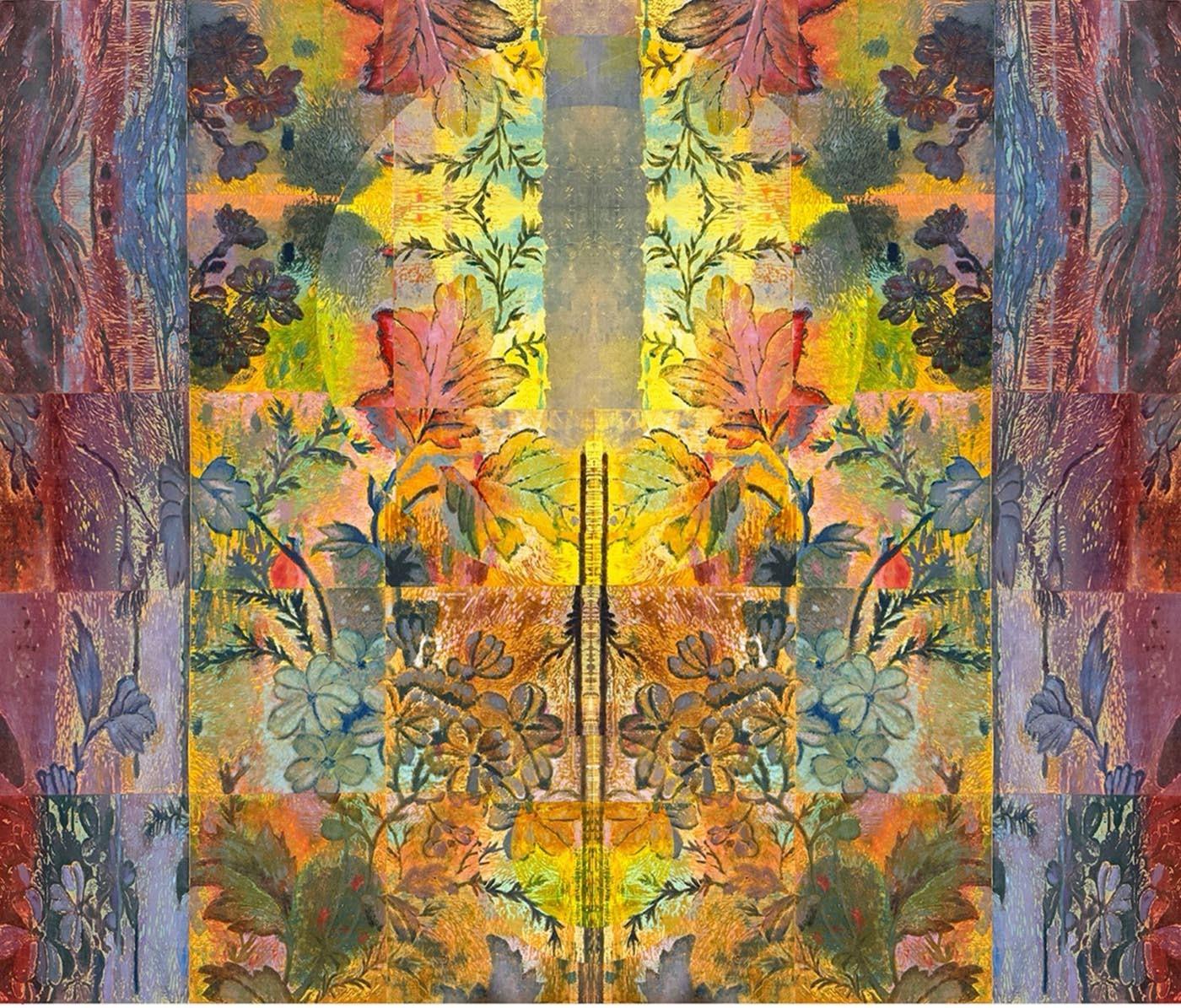
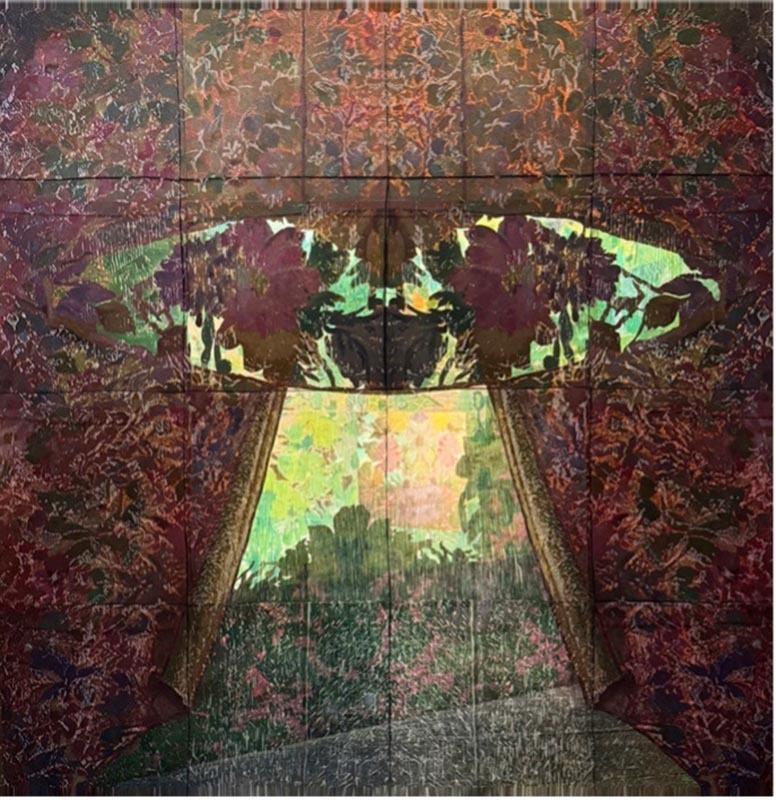
Through the Unknown, Unremembered Gate is a large-scale installation made from eighty oil and woodcut panels on linen, assembled into a single field. Each panel is formed by transferring oil pigment from hand-cut woodblocks onto the linen surface, so the image is built slowly through repeated, physical acts of pressure and touch. The work grows through mirroring and fragmentation, so what might begin as a small observational drawing becomes something architectural and immersive.
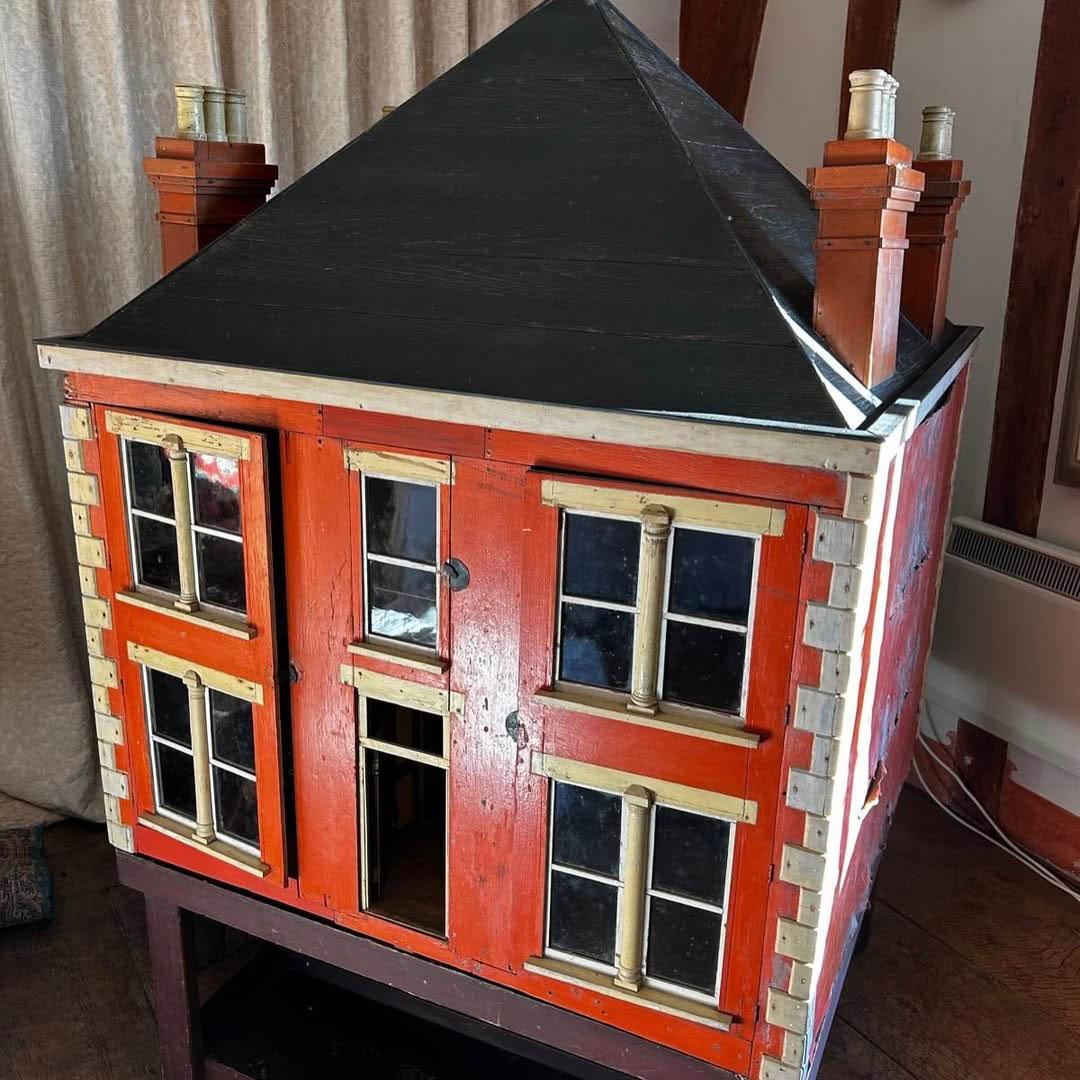
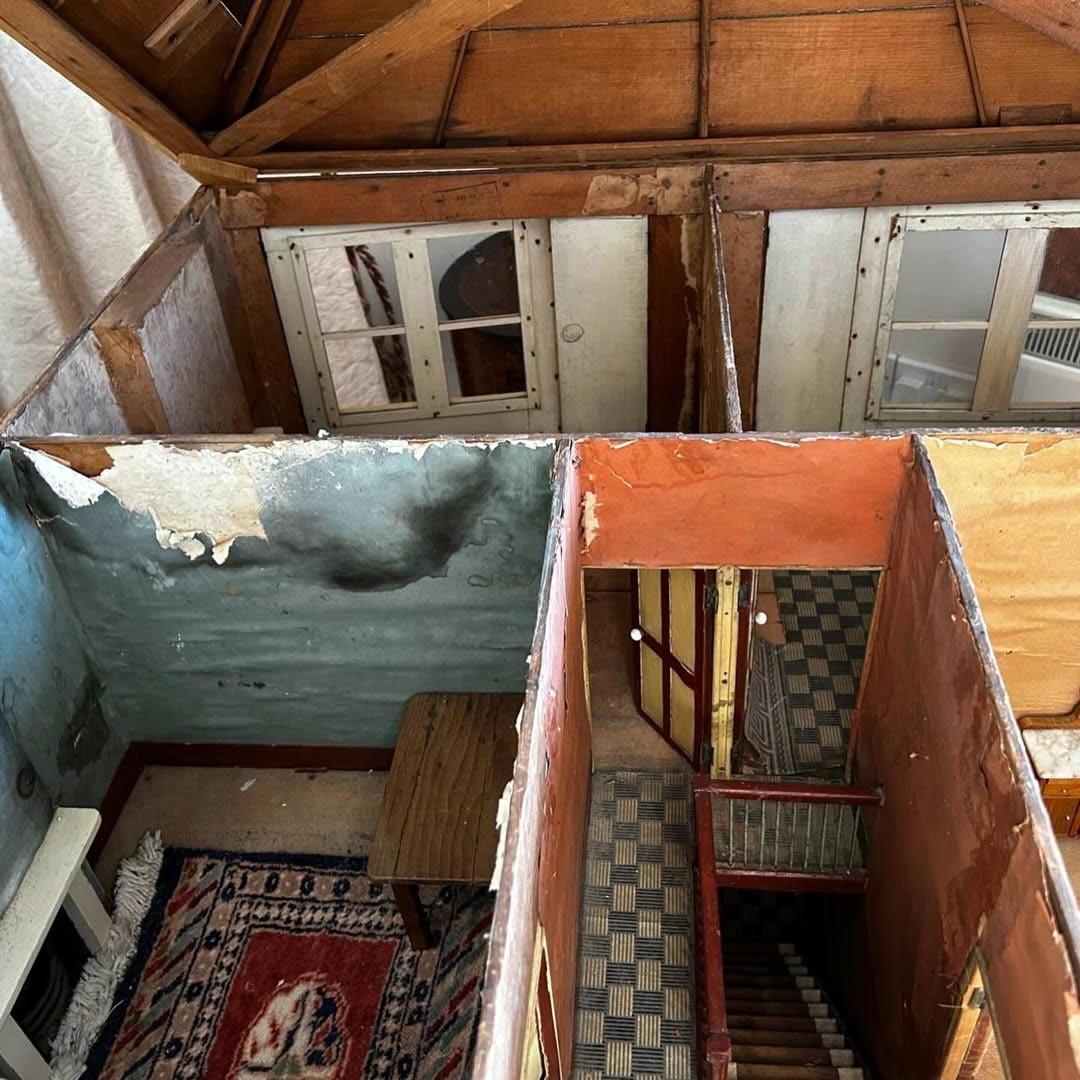
The title draws from T. S. Eliot’s writing and reflects my interest in thresholds and moments of passing between known and unknown states. The “gate” operates as both a psychological and spatial metaphor, an opening into memory, uncertainty, and imagined space. This interest in passageways, corridors, and portals is an ongoing thread in my work that goes back to childhood, growing out of a fascination with a Victorian dolls’ house I played with. The aerial views of its rooms and corridors became early internal architectures, shaping how I think about space as something you enter psychologically as well as physically.
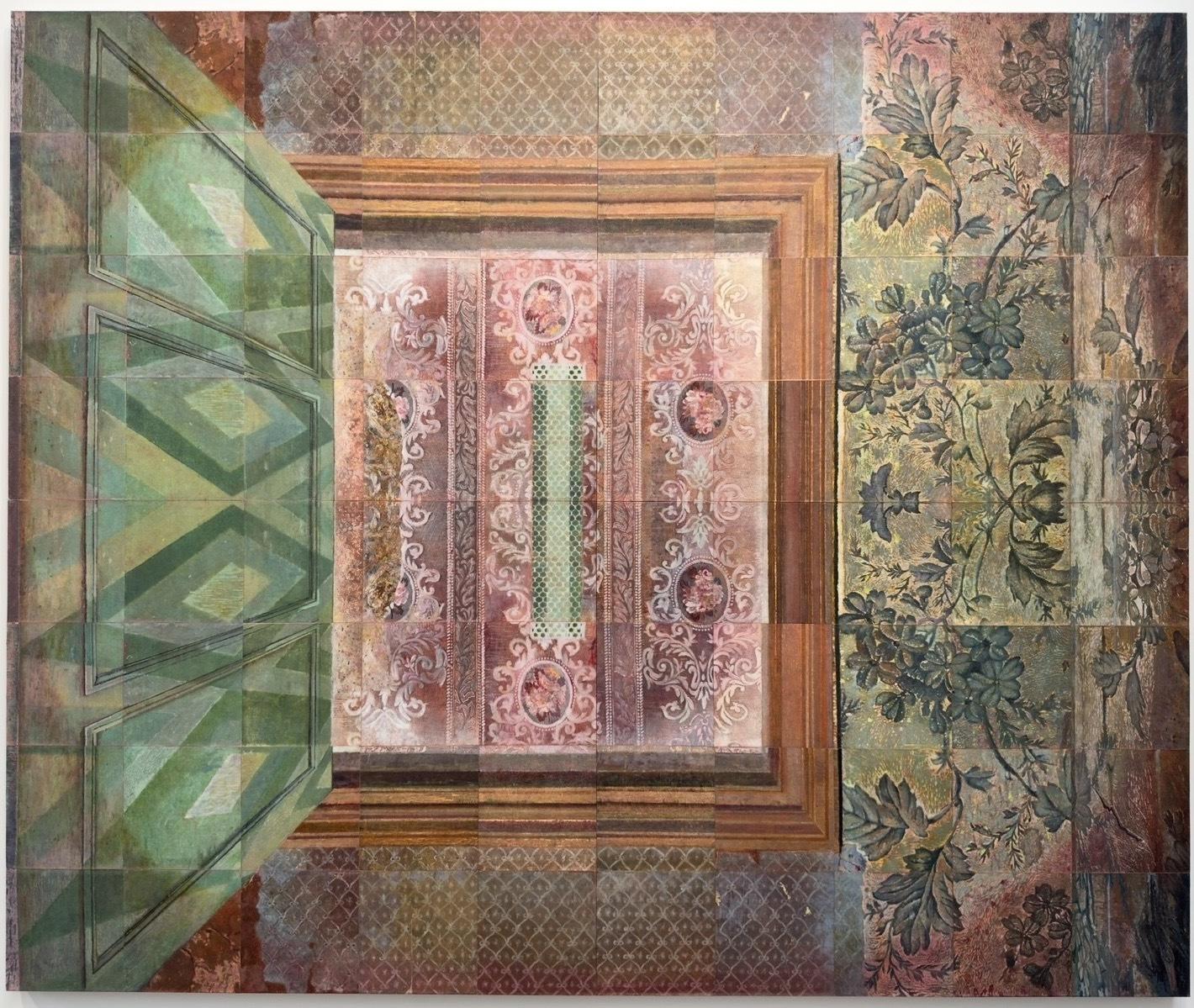
I also grew up in semi derelict historical houses in need of full renovation by my oil painting restorer mother and artist father. The work invites slow looking. The image never fully resolves. It shifts as you move, suggesting that memory and perception are always partial, layered, and unstable. My process is rooted in traditional methods appropriated in unconventional ways. Hybridising painting and printmaking and usual alternative surfaces.
Your work reframes landscape as something internal rather than observed. When you’re beginning a new piece, where does that ‘inner landscape’ first surface — in memory, material, or space?
The inner landscape surfaces through a tangle of memory, found material, and the quiet strangeness of domestic space. It often begins with overlooked things: salvaged wallpaper, fragments of architectural detail, a flat motif, or part of a doorframe uncovered during renovation. I become transfixed by these surfaces marked by time, things destined for the skip that feel loaded with presence and possibility. They become props or prompts, thresholds, portals, or barriers that lead me into the work.
From there, material begins to speak back. The resistance of linen, the translucency of silk, and the pressure of printmaking processes start to shape the direction of the work. These fragments are not purely visual references but carriers of memory and feeling. Through layering, mirroring, and surface modulation, I try to give depth to what was flat, to animate the decorative and the discarded.
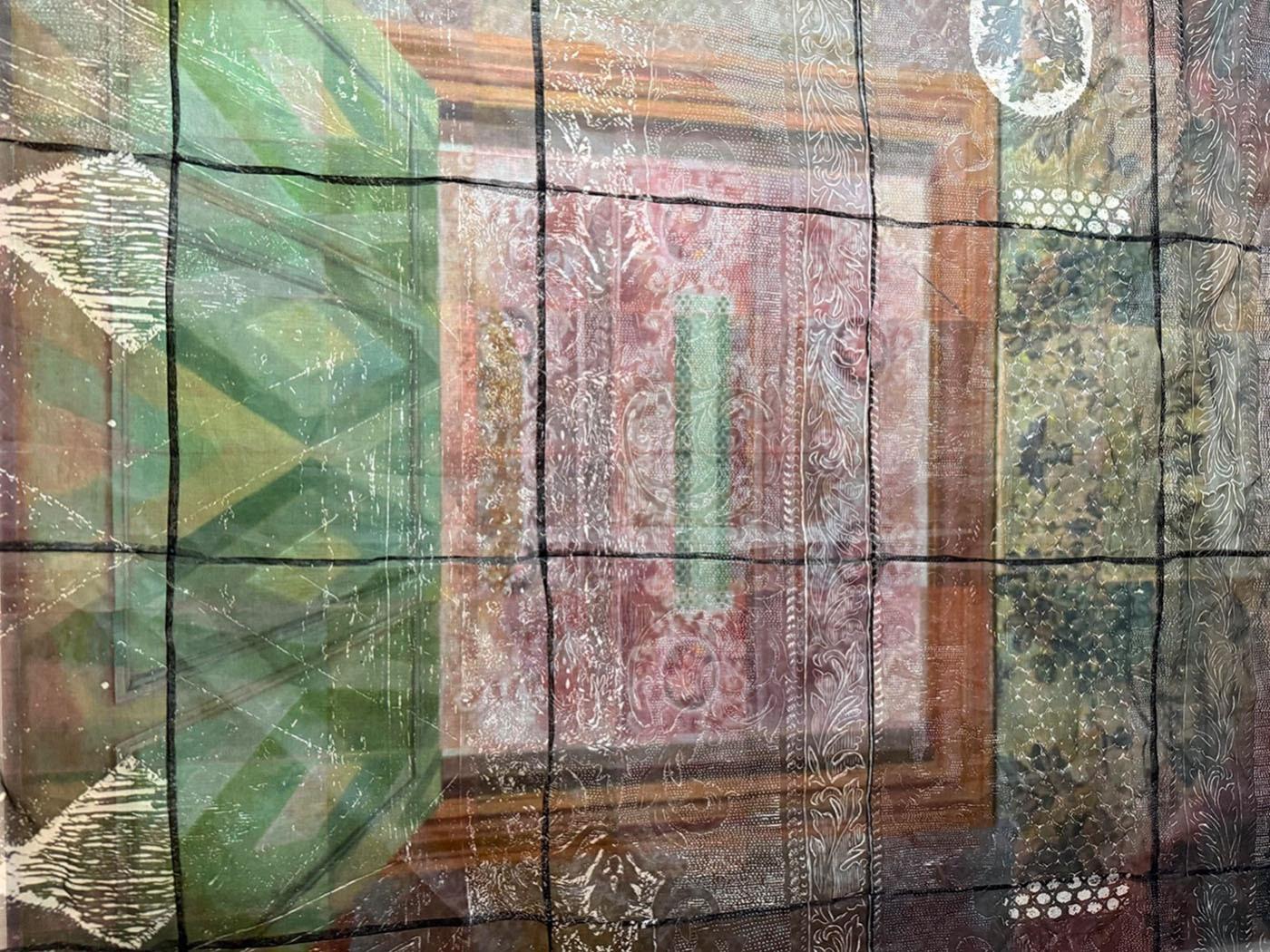
The “inner landscape” emerges somewhere between memory and material. It isn’t planned in advance. It’s constructed slowly through making, revisiting, and responding to what the surface reveals over time. In this way, surface becomes more than a plane; it becomes a space to enter. The work grows through a slow, tactile process where painting behaves like architecture, almost like archaeology, uncovering what might otherwise remain buried or unseen.
The resulting compositions form an internalised landscape: not observed, but felt; assembled rather than depicted. They are shaped by dissonance, repetition, and the friction between order and collapse. These are spaces where perception slips and memory is staged, a place where everything flows.
Looking at your paintings, they feel like sanctuaries - places of stillness that sit in quiet tension with instability. How conscious is that response to the wider world when you’re working, and does it shift over time?
That tension is very conscious, though it shifts depending on what’s happening around me and in the wider world. I’m drawn to making spaces that offer a pause or moment of stillness, but never complete comfort. There is always an underlying instability or sense that things could shift or dissolve. That feels closer to lived experience than any idea of fixed calm.
I’m fascinated by contradiction and the idea of creating a fragile equilibrium. The works often hold opposing states at once: quiet and tension, care and collapse, order and disintegration. The grid and the use of doubling or mirroring become ways of framing chaos, of giving structure to something that is inherently unstable. They act as scaffolds that hold the work together while allowing it to slip, distort, or unravel.
Domestic patterning — wallpaper, textiles, architectural detail — plays a central role in your visual language. What is it about these historically ‘decorative’ structures that feels psychologically charged for you?
Wallpaper, textiles, and architectural motifs are psychologically charged for me because they sit at the intersection of comfort and control. These decorative structures were designed to domesticate space, to impose order, pattern, and rhythm onto lived environments. Over time, though, they absorb memory, presence, absence, and emotional residue. They become quiet witnesses to daily life, repair, neglect, and decay.
I’m interested in how domestic surfaces can shift from comfort into something more psychologically charged or uncanny. Charlotte Perkins Gilman’s The Yellow Wallpaper is an important reference for me in this regard, where decoration becomes oppressive, hallucinatory, and destabilising. By extracting and reconstructing these motifs through print and paint, pattern shifts from ornament into structure, from background into a form of psychological architecture. These surfaces begin to carry memory and tension, rather than simply functioning as decoration.
Your work also pushes painting into spatial and textile environments, destabilising time and memory. How does working beyond the wall change your understanding of what a painting can hold?
Working beyond the wall shifts painting from being something you stand in front of to something you move through, but for me this didn’t mean abandoning the painted surface. It meant embracing and extending it, enhancing the sense of ambience and curiosity around what the image might hold. For a long time, I was painting passageways, corridors, and thresholds in two dimensions, always wanting to see what might be around the corner or beyond the frame. This desire led me to introduce spatial elements that activate the painting without leaving it behind.
The painted work remains two-dimensional, but the addition of printed silk veils brings a spatial layer into play. These veils sit in front of the painting like ghost images or afterimages, holding earlier moments of the work in suspension. The viewer’s gaze becomes caught between layers, between what is present and what has already passed. You’re looking at multiple moments at once, as if time has folded back on itself.
As people move through the work, they become part of the composition themselves, momentarily caught within these layered thresholds. Their movement activates the work, and in that sense, they are also held in time, folded into the shifting relationship between surface, shadow, reflection, and memory.
Light plays a crucial role in this. Painted light and natural or artificial light passing through the layers behave differently as conditions change over time. I also use lighting devices and visual language borrowed from photography and cinema, such as lens flare, vignetting, bleaching out, and working at very low light levels. The physics of light interacting with thin paper, oil pigment, and silk produces subtle shifts in colour, opacity, and reflection. This interplay creates an ambience that is never fixed. The work changes with the light, so perception becomes temporal as well as spatial.
You currently have an incredible show entitled Echo Chamber & The Seeds of the Narcissi at @m2_gallery_london in Peckham. Could you talk us through this current body of work? Any specific themes?
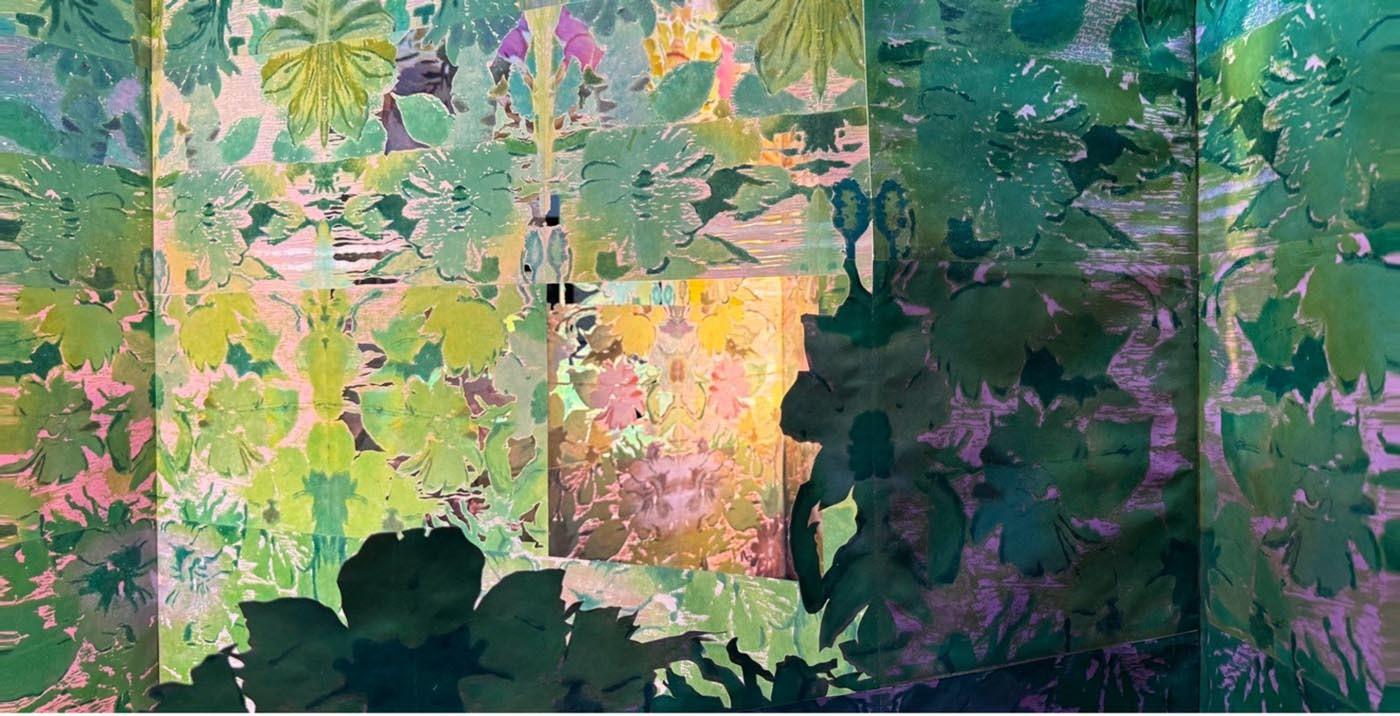
The site-specific installation, Echo Chamber & The Seeds of the Narcissi, in my current solo exhibition @m2_gallery_london draws on the myth of Echo and Narcissus as a way of thinking about repetition, reflection, projection and self-encounter. . Echo’s voice, endlessly repeating fragments of what is heard, becomes a metaphor for how images circulate, distort and return through my process of mirroring and layering. Narcissus’ fixation on his reflection speaks to themes of self-projection, illusion and the seduction of surfaces and the way we become absorbed in images that both reveal and withhold.
The exhibition brings these ideas into spatial form through a series of site-specific installations developed for M2’s pavilion space. The structures function like chambers of looking and places where vision is channelled through apertures and layers, drawing on the idea of the hagioscope or medieval “squint”. This way of seeing is partial and intimate, echoing childhood fascinations with peep-shows and doll’s houses, the spaces where interior worlds are staged and encountered through small openings.
The pavilion itself shapes how the work is experienced. It can be viewed from the street and from all four sides through windows once entering through the gate. Each position offers a different register of encounter:
• Front window: inner world, illusion, memory, projection
• Side & rear windows: process, labour, material construction
This dual reading reflects the logic of the work itself — how inner landscapes are built from fragments, supports and hidden frameworks. The installations resist a single ‘correct’ viewpoint, instead unfolding through multiple, shifting perspectives.
Alongside the pavilion installation, a smaller work titled Evergreen occupies M2’s metre space. Here, viewers peer through diamond patterned green ‘doors’ into an autumnal, jungle-like interior, punctured by a cut-through lens flare towards a neon yellow light source. It functions as a compressed, almost theatrical encounter with the exhibition’s themes — a miniature portal that plays with illusion, desire, and the act of looking itself.
The exhibition is accompanied by a soundscape by Max ‘Panix’ Wray, accessed via QR code, which adds another layer of echo, resonance and psychological atmosphere to the viewing experience.
There are additional artworks on view by appointment inside, that provide a background to my creative journey, including the previously mentioned installation- ‘Through The Unknown Unremembered Gate’, drawing and curious mini maquette of the site-specific installations.
Together, the works explore how images echo, how selves are projected into spaces of reflection, and how looking becomes an act of desire, repetition and distortion rather than passive observation.
This is the final week of Echo Chamber & The Seeds of the Narcissi.
Additional artworks inside are viewable by appointment.
Join us for a finissage on Saturday 14 March, 5–7pm.
Enquiries @m2_gallery_london

If we were to walk into your studio, what kind of materials would we find? What are your go-to studio essentials?
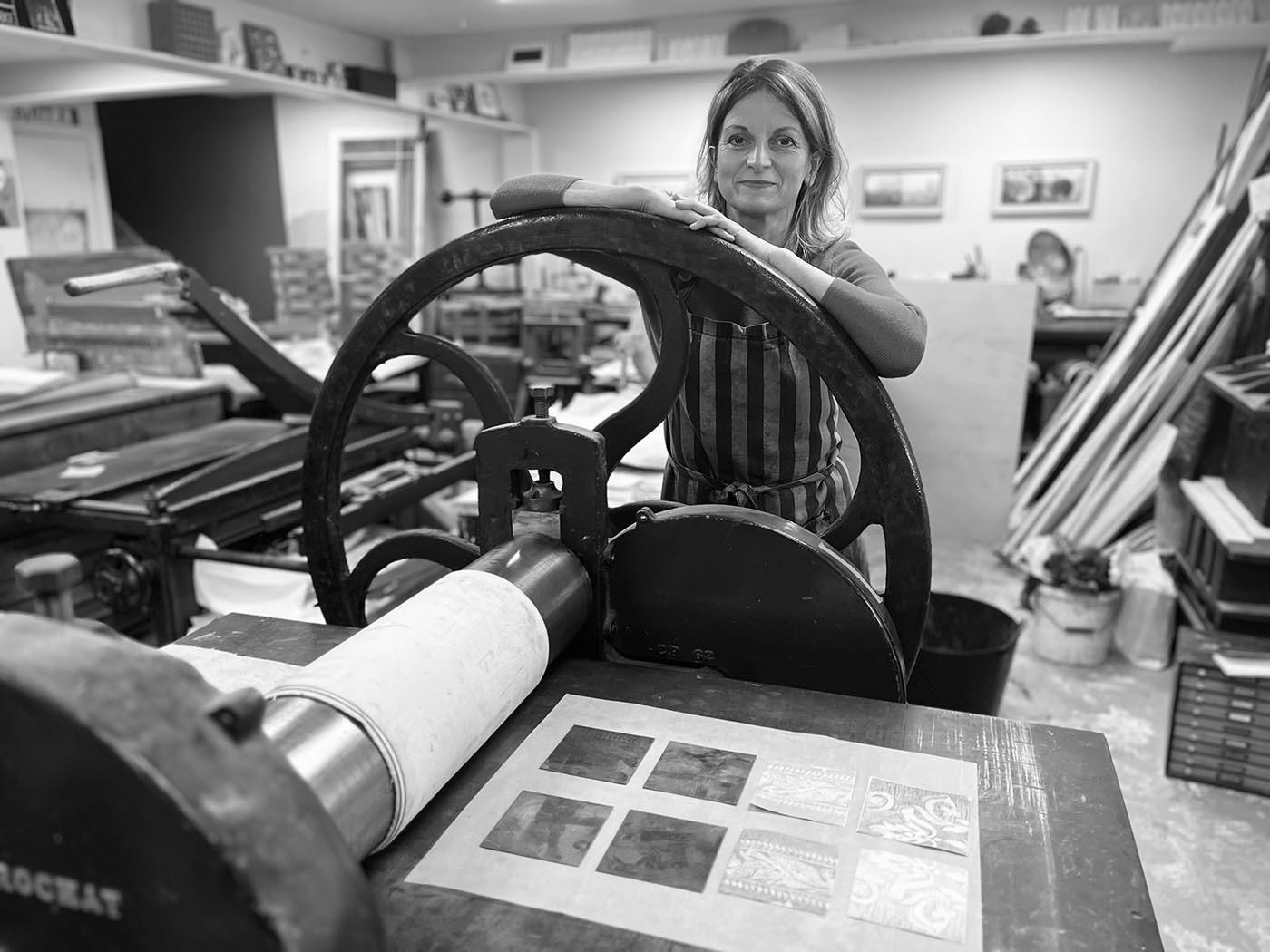
I work in a live/work space, so the home is a fundamental part of my studio practice. The basement functions as a workshop, housing the heavy machinery needed for cutting, printing and pressing: a Rochat press, board chopper, band saw, several book presses and stacks of pressing boards. It’s a place of physical labour and making, where scale is negotiated through tools as much as through materials.
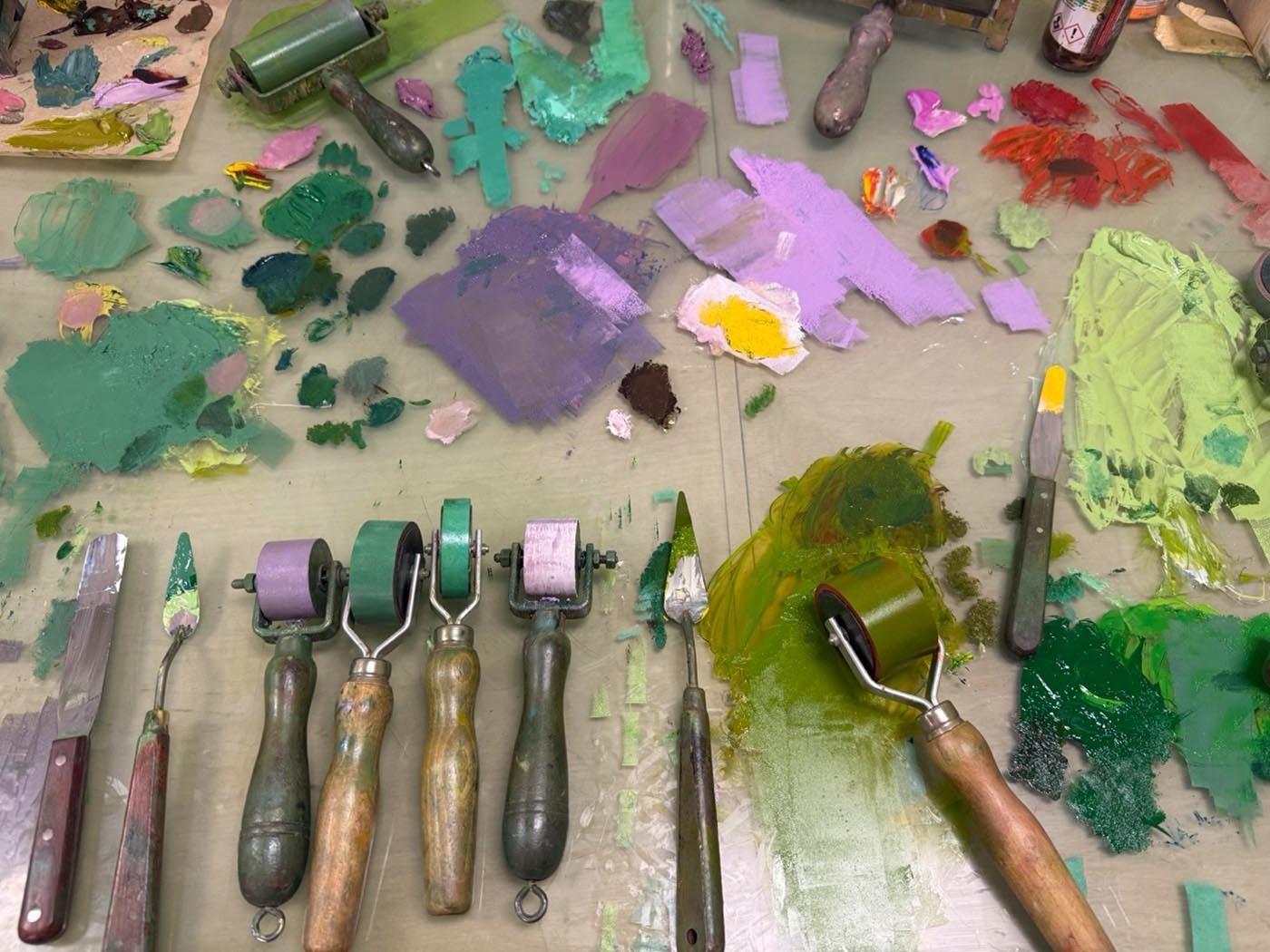
Large glass surfaces provide space for rolling out ink and spreading multiple printing plates, most recently hundreds of woodcut blocks at once. Around this, piles of discarded prints and offcuts accumulate, alongside tins of printing ink, rollers, palette knives and brushes in constant use. It’s an organised space, but often a hive of activity, where hundreds of printed fragments are generated before being spliced and reassembled into larger works. A double hatch in the ceiling becomes an escape route for large works as they outgrow the studio and move up into the house and hopefully into a collector’s home.
I also have a separate space dedicated to painting. The walls are covered in Sundeala board so I can pin up hundreds of primed linen panels with dressmaking pins to then build up paint surfaces on them. Over time, residual marks are left behind from previous works, so the walls become a quiet archive of the making process. All the work surfaces are on castors, allowing the studio to shift as the work evolves. There are more large glass surfaces for rolling out oil pigment and laying out prints in sequence.
Alongside this, I have a third space in Peckham that functions as a clean space and quiet working area, used for storage, planning and more office-based work. It provides a necessary contrast to the mess and material intensity of the main studio, offering space for editing, sequencing and thinking through projects at a different pace, and a small but vital sense of escape.
There’s a beautiful old plan chest with ornate brass bin pulls, allegedly once belonging to Carel Weight, which I use to store print editions and works on paper. Bookshelves hold my go-to references:
A Frans Hals exhibition catalogue,
Mary Gartside, An Essay on Light and Shade on Colours,
a book on North Korean relief printmaking,
Ralph Mayer, The Artist’s Handbook of Materials and Techniques,
Lucinda Hawksley, Bitten by Witch Fever (on arsenic in Victorian wallpaper and toxic domestic interiors),
and a first edition of T.S. Eliot’s Four Quartets are few recents.
Stacks of unused stretchers lean against the walls, waiting to be activated. The architecture of the space itself feeds into the work: Victorian door frames, hand-painted furniture, and traces of past lives in the building often find their way back into the imagery. The studio is not a neutral container but an active reference point, where domestic detail, historical residue, and making are constantly in dialogue. The colours of the domestic and working environment are intrinsically linked to the palette within the work itself. The studio quietly feeds the paintings back to me, with greens and pinks recurring again and again as if absorbed from the space over time.
Bella, you’ve been very generous with your time. If you can, could you let our audience know what they can look forward to from you in 2026?
2026 feels like a year of consolidation and expansion for me. I’m continuing to develop large-scale, site-responsive installations that push printmaking further into architectural and experiential form, allowing printed surfaces to be entered, navigated and encountered physically. I’m interested in extending the language of Echo Chamber & The Seeds of the Narcissi into new contexts, testing how these chamber-like structures behave in different sites and how light, sound and movement alter their psychological charge.
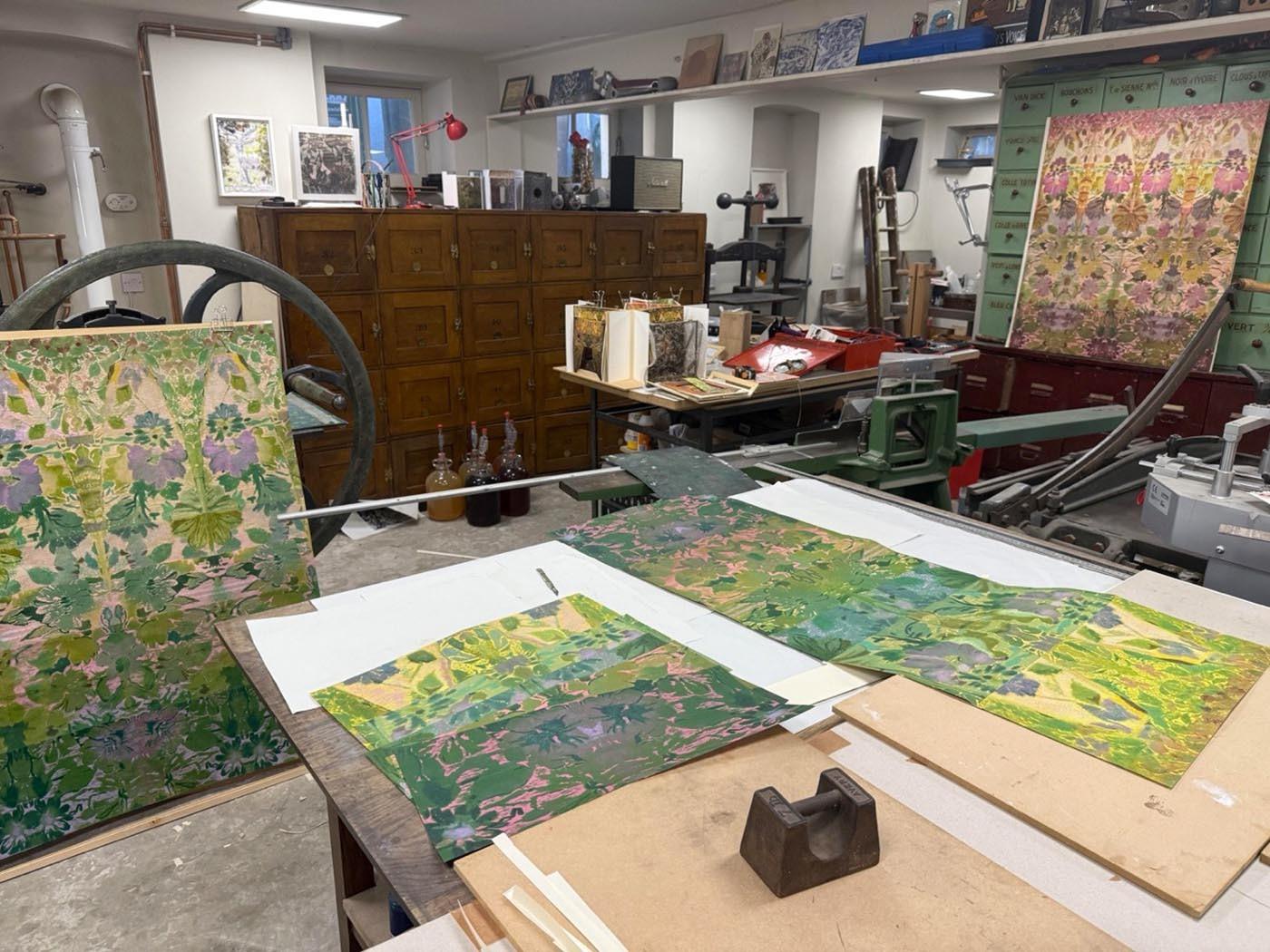
Alongside this, I’m working on translating elements of the installations back into individual works on paper and linen, allowing fragments of these environments to exist independently as prints and collaged compositions. This feels like a way of letting the work live beyond a single exhibition, carrying traces of the spatial experience into more intimate formats.
I began 2026 not only with my solo exhibition at https://m2gallery.com, but also with work included in a group exhibition with Irving Gallery in Oxford. I’ve also just submitted two large, related woodcut print works to the Royal Academy Summer Exhibition, so fingers crossed. In May, The Violet Hour will be presenting new works of mine as part of their Anthologia curated online exhibition series, which I’m really excited to be part of.
Alongside my own practice, I curate under BEASTON Projects and am currently developing the sixth iteration of an ongoing project and living archive, Collateral Drawing, which will be presented at A.P.T Gallery in Deptford in October 2026. Collateral Drawing invites artists to exhibit both a finished artwork and selected byproducts of their creative process, such as sketches, notes, offcuts, test pieces or experiments. These fragments offer insight into material thinking and making, reframing what is often discarded as vital evidence of artistic labour. Over time, these contributions form a growing, publicly accessible archive that celebrates transparency, process and the expanded field of drawing.
Public engagement will remain central to my practice. I’m developing print-based interventions, workshops and collaborative projects that extend the work beyond the gallery and into everyday spaces, continuing my interest in printmaking as a material, spatial and social practice. The work will keep circling questions of memory, perception and interior space, but in ways that are increasingly porous, mobile and responsive to where and how it is encountered.