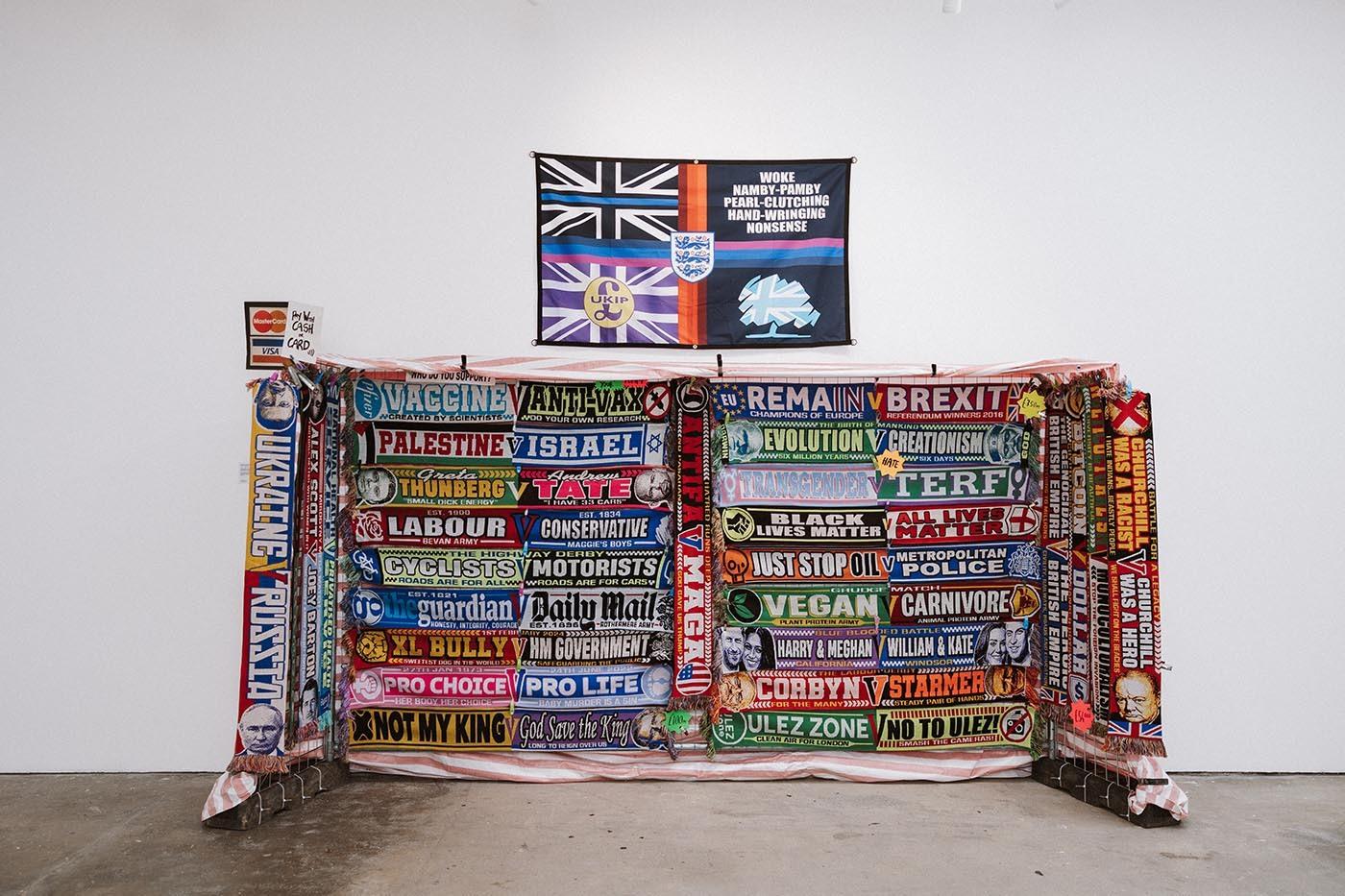
Satirical artist WOTW (W*ankers of the world) won The Cass Art Prize receiving a £10,000 cash prize and exhibited his work at free stand at The Other Art Fair. Their installation 'Who Do You Support' was selected by our prestigious panel of judges, and explores the relationship between politics and football by reimagining the notorious ‘half-and-half’ scarf. We caught up with WOTW at his studio to speak about his unique and powerful practice.
Your piece “Who do you support?” won the 2025 Cass Art Prize. It reimagines culture wars and divisive politics using the controversial football “half and half” scarves. Could you talk us through the process of creating such an incredible piece of work?
In 2024, I curated a show exploring the relationship between football and politics. The exhibition was titled Shut Up and Stick to Football, a phrase commonly used by right-wing commentators and politicians to dismiss footballers who speak out on social issues. I wanted to create a piece that tapped into the febrile nature of modern political discourse, but also addressed the commercialisation and commodification of our national game. As global money has flooded into football over the last 35 years, the sport has morphed into a sort of consumer ‘product’, eroding authentic fan tribalism. The notorious half-and-half scarf - with two opposing teams featured on the same scarf- has become symbolic of this trend. While the hatred between football fans has been diluted, wider society has become more divided and tribal than ever, with the so-called ‘culture war’ fuelling animosity between opposing political views. We’re now more likely to change our football team than acknowledge any weakness in our political ideology. The way people defend their entrenched beliefs is very similar to that of a hardcore fan supporting their team through thick and thin.
The half-and-half scarf is obviously widely disliked by ‘proper fans’. What interested you about using an object that already carries a kind of cultural resentment?
As I’ve explained, the half-and-half scarf does seem to represent everything wrong with modern football. They’re predominantly bought by tourists and have become a symbol of the sanitised fan experience. It would’ve seemed insane 30 years ago to have Liverpool - Manchester United or Tottenham - Arsenal on the same scarf. The initial idea of using political ‘teams’ on the scarfs came about in the aftermath of the October 7th attack and the ensuing Israeli military response. This moment seemed to polarise the world more than ever, and there seemed to be very little nuance in the debate. I initially just thought about doing a Palestine vs Israel scarf, but then I realised that there are hundreds of ‘teams’ which we all spend hours each week cheering on from the social media terraces.
Winning the Cass Art Prize meant your work was judged alongside more traditional fine art practices. Did that context change how you see your own work — or how you think it’s read?
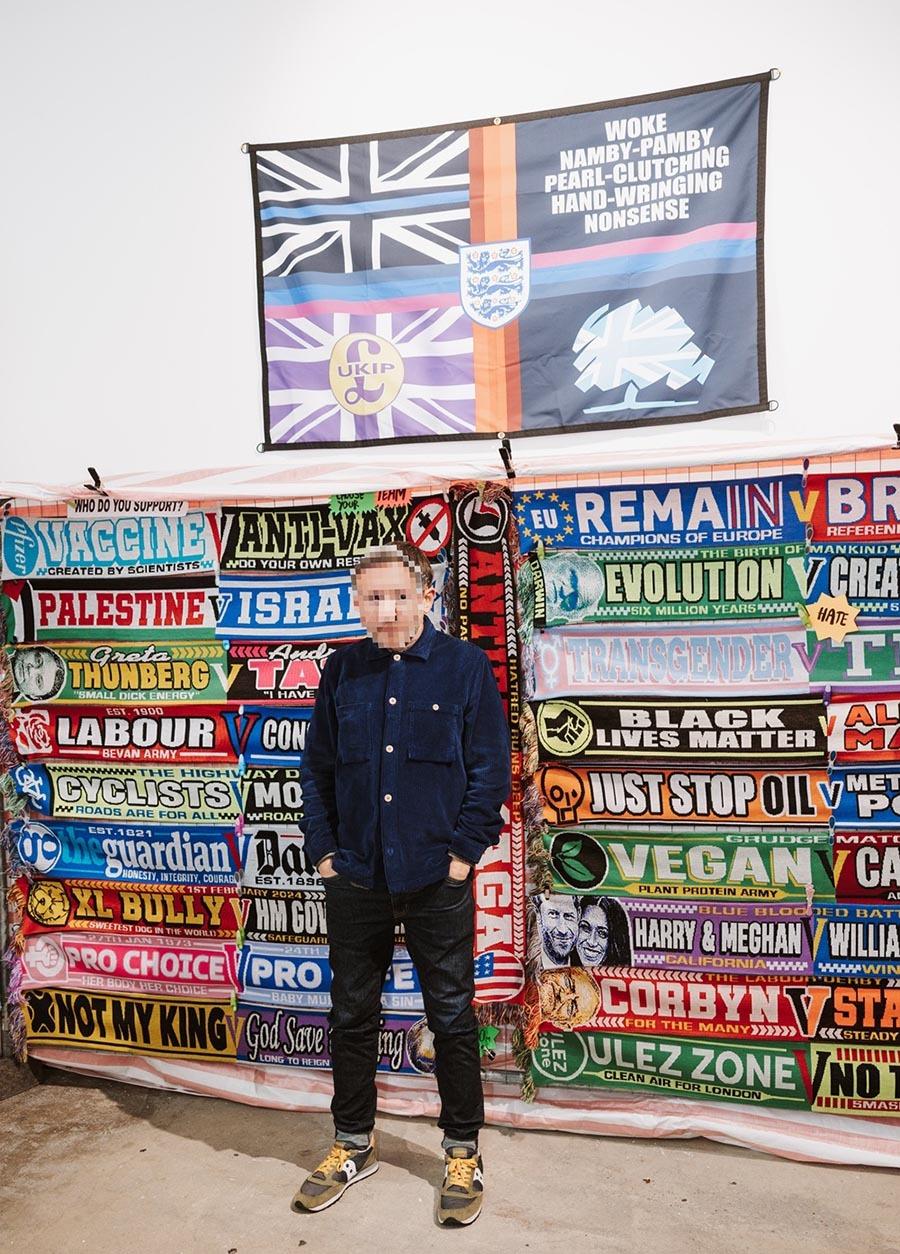
I think it’s really exciting and refreshing to have a new art award that allows space for work like mine. I’ve entered lots of competitions over the years with very little success and it does feel like the overtly political nature of my practice has been a barrier. Winning has definitely given me an injection of confidence and elevated my work beyond simple satire. Or as my 8-year-old son put it - “I thought you just did pictures of Boris Johnson with his bum out.”
Many of the pairings in the scarves represent debates that are decades or even centuries old. Do you see today’s culture wars as genuinely new, or just louder versions of long-standing conflicts?
Culture wars have always existed, but there’s something very 21st-century about this level of dogmatic commitment. Matthew d’Ancona, an editor at Tortoise Media, has written extensively about modem politicisation of culture, he notes: “There have always been cultural conflicts but it’s become much sharper in the last 20 years thanks to declining trust in institutions that were meant to hold together the cohesion of society, some of the growing inequalities, and most of all the proliferation of technology that enables and indeed encourages people to cluster in their cultural groups.” I guess the pandemic intensified these divisions, with conspiracy theories blossoming as people spent months cooped up, consuming social media and scrutinising the government.
Another driving force is the oversimplification of our modern world, where complex divisive issues are live-streamed into our homes like a never-ending World Cup tournament, with millions of wannabe pundits poring over the action 24 hours a day. This sloppy analysis is often packaged as clickbaity 30-second TikTok clips or in a single angry Tweet. We’re also in a post-truth era with bot farms, algorithms, and fake news fanning the flames.
Your work often borrows familiar visual systems — banknotes, advertising formats, football merchandise. What draws you to these everyday structures as a way of talking about power and ideology?
There’s something beautiful about everyday functional objects and design. Taking ubiquitous items and subverting them to create a message or joke gives me a real buzz. As a kid, I loved the fake adverts in Robocop (1987), Garbage Pail Kids trading cards and Viz. It’s like a sort of sleight-of-hand magic trick or a double-take. Something looks mundane and recognisable then you realise it’s actually something subversive or anarchic. I’m also obsessed with process and what makes something look like it does. Typefaces, the way photos are retouched, old printing techniques, even the rhythm of how copy is written, all fascinate and excite me. I find just as much visual inspiration inside a tourist souvenir shop as I do inside an art gallery.
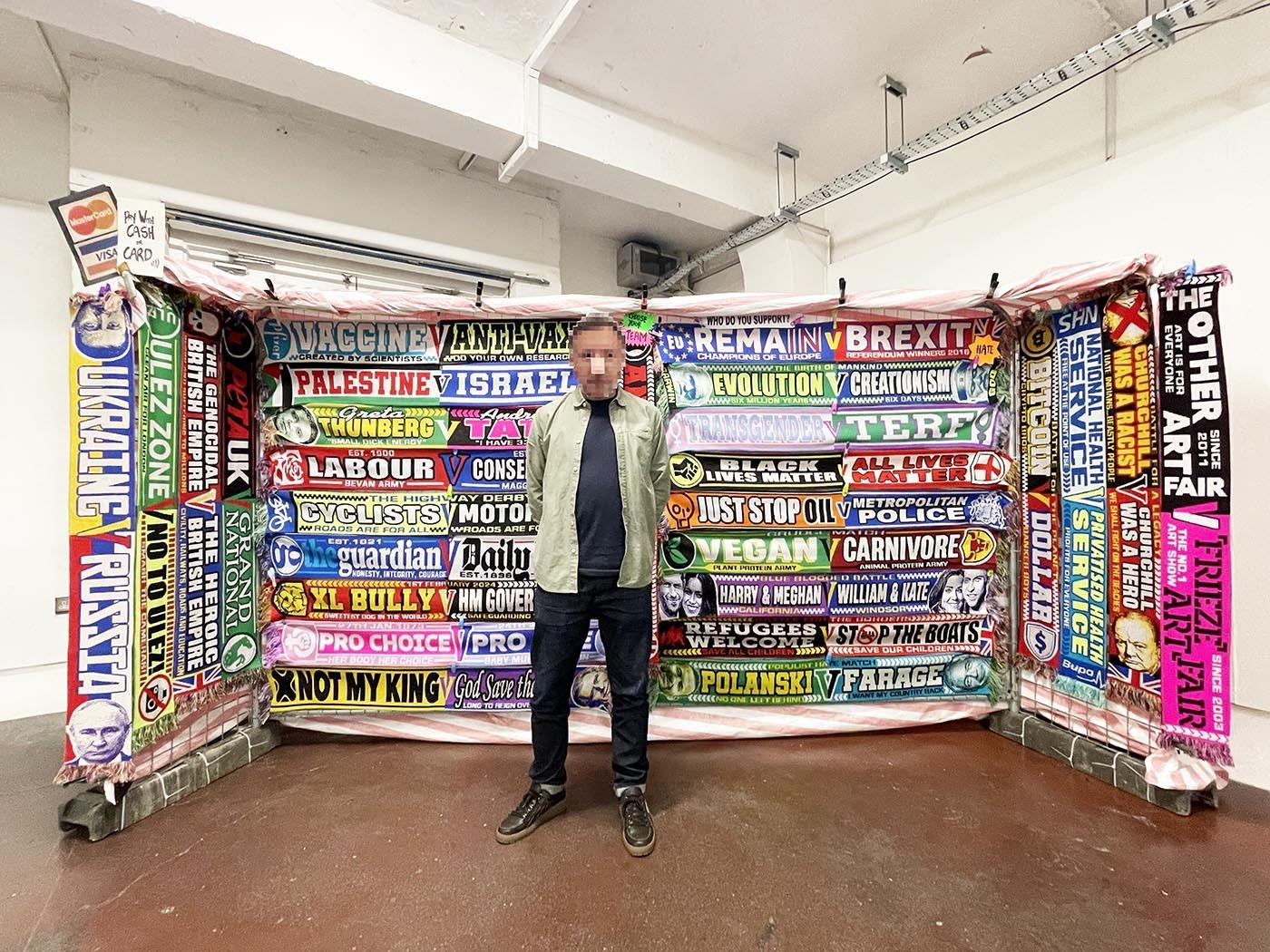
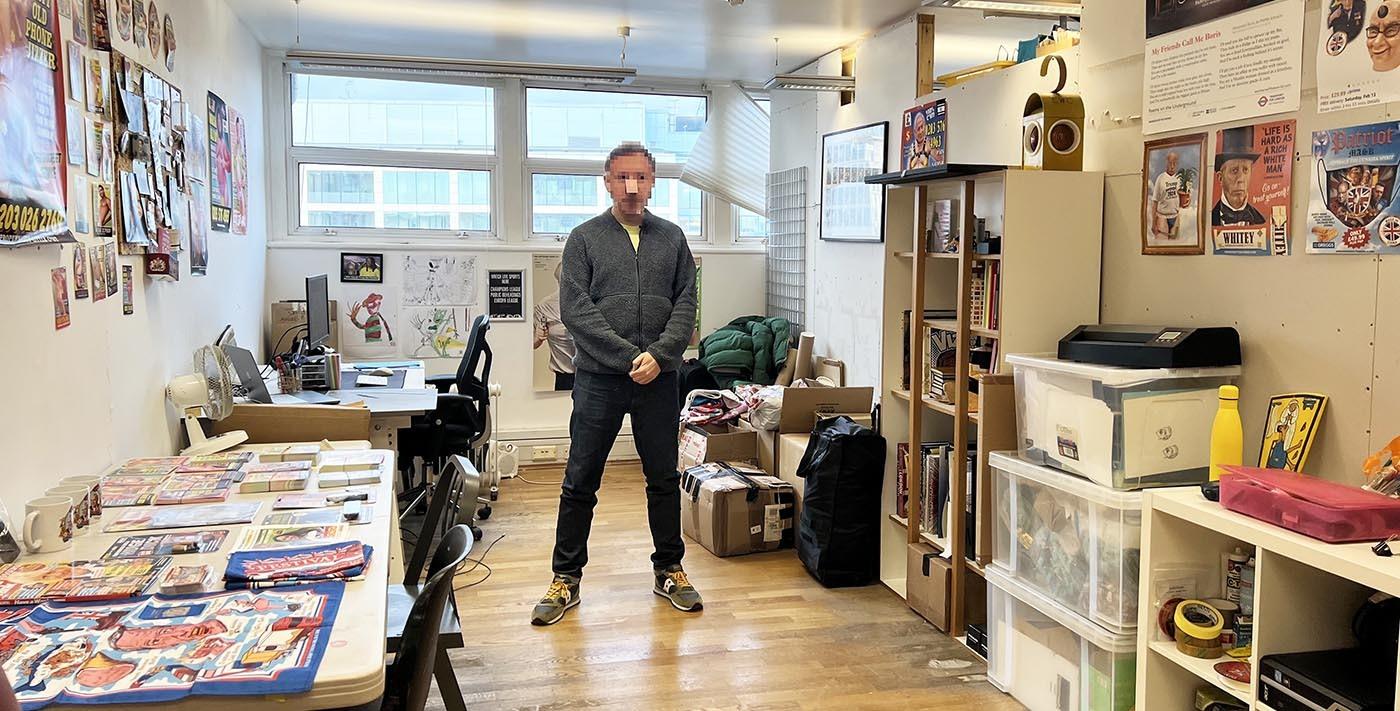
Your work anonymously and deliberately obscures your identity. What does anonymity allow you to do as an artist — and what does it take away?
The main thing it allows me to do is create highly political works without worrying about how it might affect me the person. As I’ve alluded to, this highly charged, politicised era means anyone creating work or commenting is vulnerable to attack. I also work doing (mainly) boring graphics and illustration jobs to pay my bills, and my political art practice doesn’t tend to gel very well with that universe.
Humour is central to your work, but the underlying themes are often bleak. Do you see humour as a way in, a defence mechanism, or a critical tool?
Britain is quite a pathetic country in many ways, and we spend a lot of time embarrassing ourselves on the world stage. That being said, there are areas where we are genuine world beaters: plugs, crisp flavours and humour. Our ability to laugh at ourselves is phenomenal, and this rich tradition is the perfect conduit for tackling serious social issues.
Finally, your work reflects a culture that seems increasingly unwilling to concede or compromise. Do you think art still has the capacity to soften those divisions, or is its role simply to expose them?
I’d like to think art still has the power to make someone stop and think. Being immersed in a film, a piece of music, an amazing book, or a painting that grabs you by the balls is incredible and taps into what makes us tick as humans. So the more we create the better.
Check out more of WOTW work on their website wankersoftheworld.com and follow on Instagram @wankersoftheworld
Add To List
Add a Wishlist
form to add wishlist here