
You trained at Charles H. Cecil Studios in Florence, where drawing and painting from life formed a major part of your education. How has that classical training shaped the way you work today, and are there aspects of it that you have deliberately moved away from?
My training was extraordinarily helpful to me in building a dextrous and reliable set of tools with which to approach portraiture
There are a few a few things that I do differently now — I don’t think any of them very consciously decided upon, more that adaptations have crept in overtime. For instance, I now I’m happy to use photo references as as well as my essential life sittings. That would have been taboo at the school.
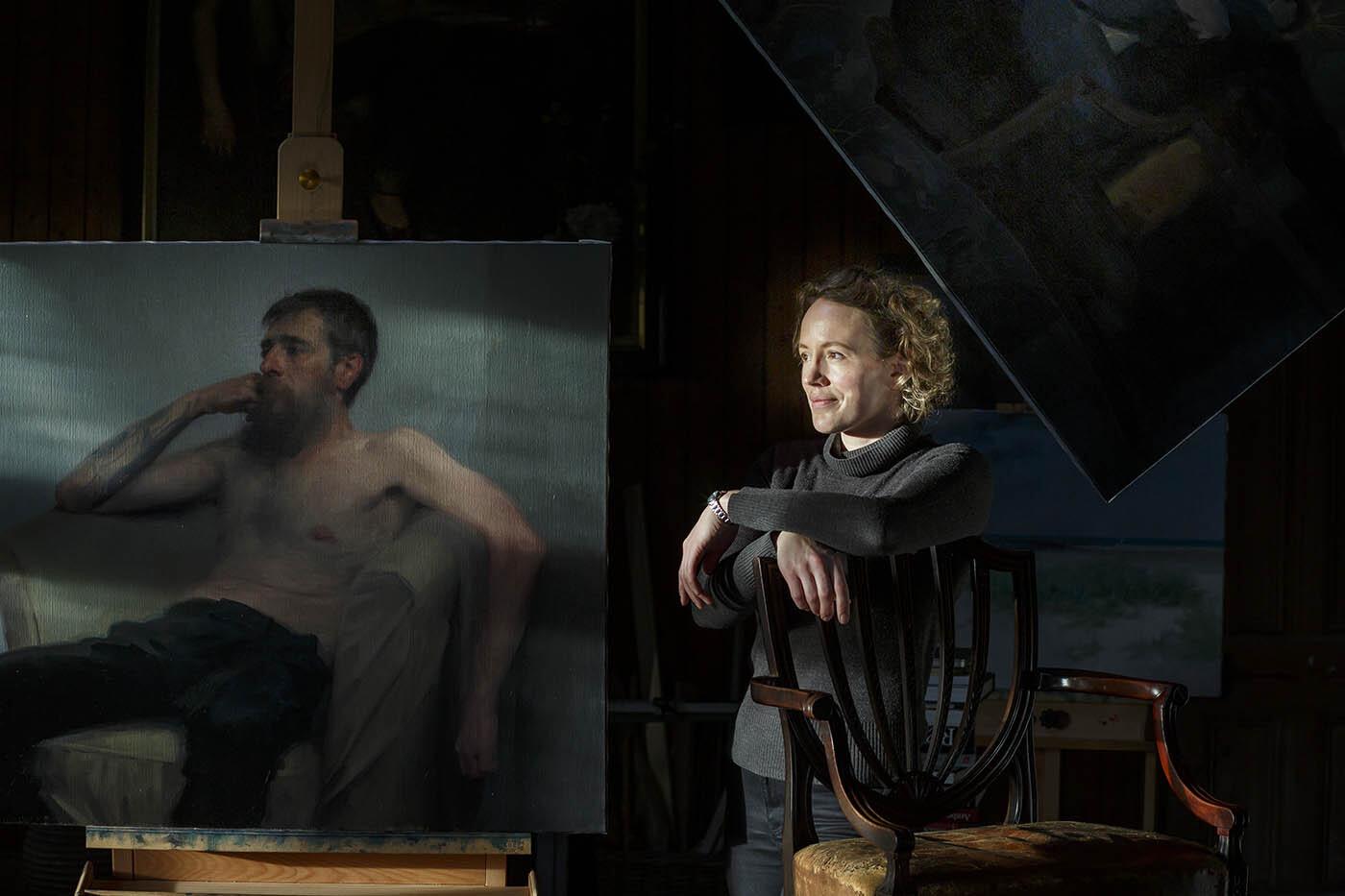
You describe portraiture as a collaboration between artist and sitter. How important is the relationship that develops during a sitting, and what can you learn about somebody through painting them that you might not discover otherwise?
I view my sitters very much as part of my process, and in fact, the sitters nearest and dearest as well in the form of expert witnesses to my sitter.
In taking time directly with people as they behave normally during sittings, you are gaining from them an observed knowledge of natural behaviours and gestures which will likely inform your painting process.
I can’t comment for other methods, but I find that sitting time with my models in valuable.
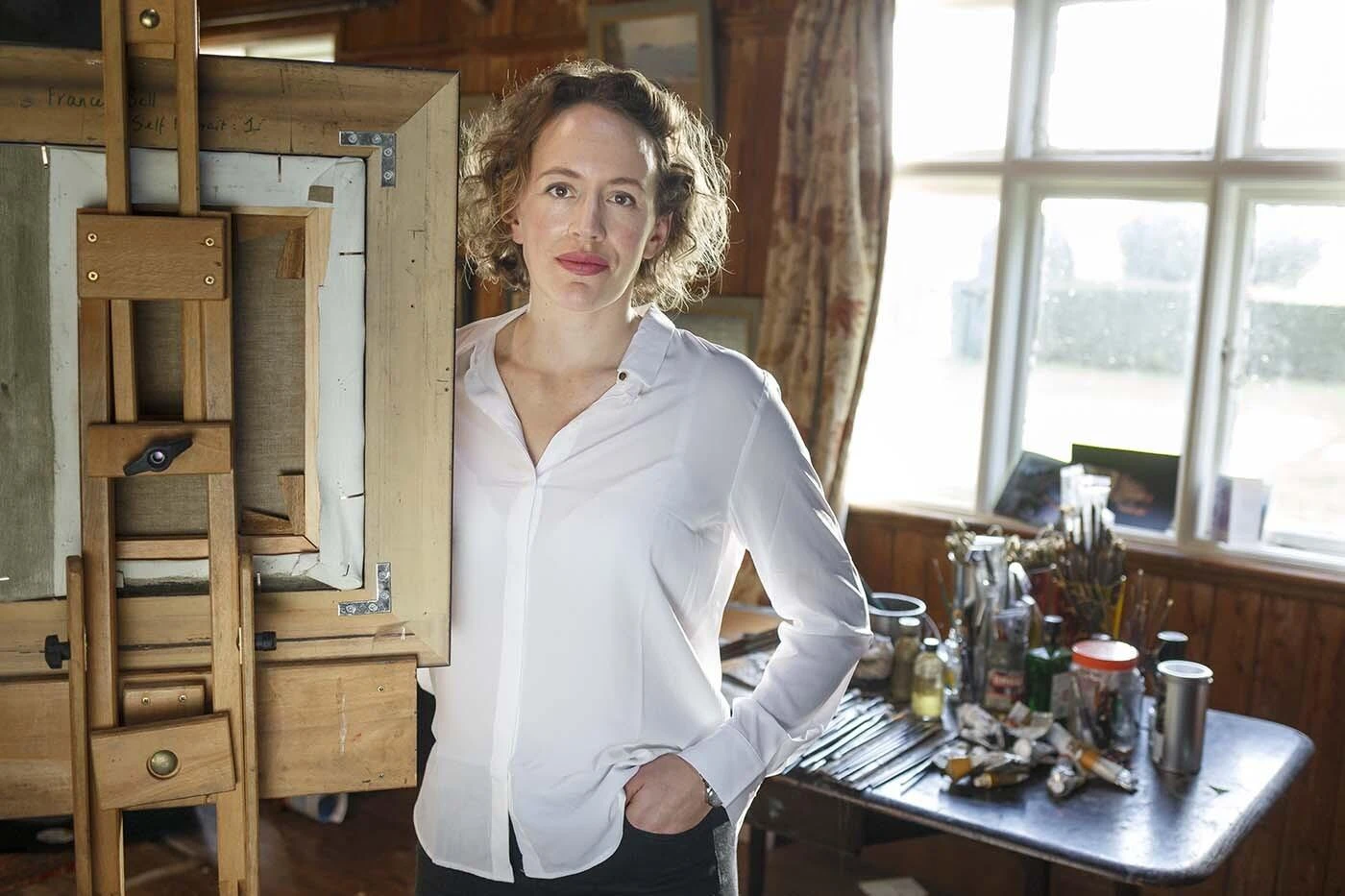
You often begin directly on the canvas without preparatory sketches, gradually building and adjusting the painting as it develops. What appeals to you about keeping that process open, and how do you know when a portrait has finally resolved itself?
When a painting is complete is a ticklish conundrum! It comes down to feel and instinct in the end.
As for starting a project, I do tend to want to see the skeleton of the composition at the actual scale and therefore, given that it is consonant with my technique to work in layers, I am very comfortable laying in directly onto the canvas. In the case of very large compositions of multiple people, this would not be practical, but I tend to get head studies and then lay in the larger painting from those, with the use of photos to aid my memory.
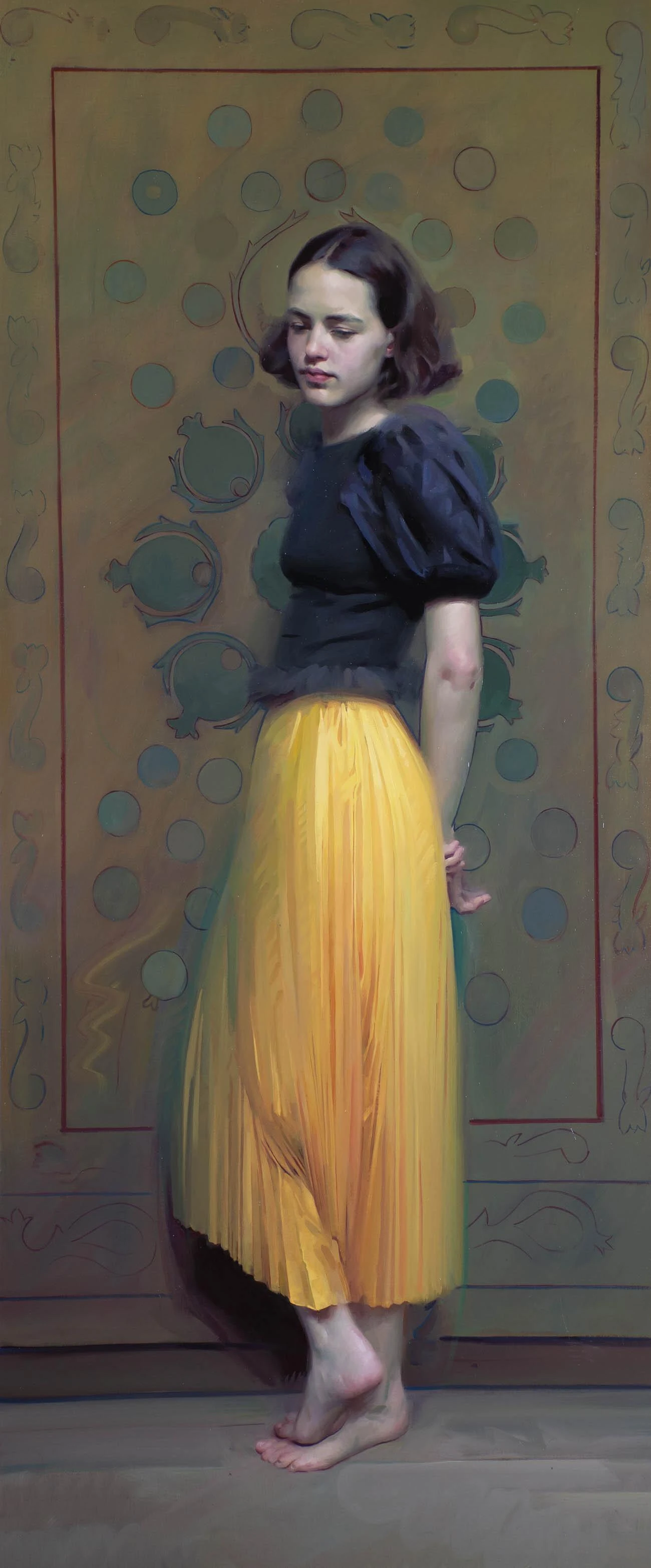
Turning Thirteen
You often begin directly on the canvas without preparatory sketches, gradually building and adjusting the painting as it develops. What appeals to you about keeping that process open, and how do you know when a portrait has finally resolved itself?
When a painting is complete is a ticklish conundrum! It comes down to feel and instinct in the end.
As for starting a project, I do tend to want to see the skeleton of the composition at the actual scale and therefore, given that it is consonant with my technique to work in layers, I am very comfortable laying in directly onto the canvas. In the case of very large compositions of multiple people, this would not be practical, but I tend to get head studies and then lay in the larger painting from those, with the use of photos to aid my memory.
What follows is a collaborative process between myself and my sitters, and their families, as they will help me judge how true to reality my portrait is running.
On this note, could you let us know what your go-to art materials are? What are your studio essentials?
I paint on linen and panels, the linen is often a Claessens Oil primed linen, and the panels could be from a number of companies, but I like Raymar and Artefax primed panels.
Brushes also come from many places - rosemary’s brushes, silver brush. They are mostly long handled filberts, rounds and squares in hog, but also a few synthetic Sable options.
Paint tends to come from Old Holland and Michael Harding.
I order sun thickened linseed oil for my medium from Zecchi in florence, along with Canada Balsam, which I use very sparingly.
Much of your work is painted from life over extended sittings. In a culture increasingly dominated by photography and instant images, what do you think the slowness of painting from life can reveal about a person?
As I have mentioned, I use both life sittings and photography, though not to copy from - more to remind me of the sittings, and photographs are invaluable for clothes and details. I think the importance of sittings to gain direct recording of your composition is paramount , but also the opportunity to see models behave naturally as well. To this extent, I always try to keep conversation with my models going, so that through natural dialogue they relax, and I can see their gestures come through.
Without the sittings, I feel adrift, that will probably find its way into the canvas.
I don’t object in principle to using photographs, we live in a time where realistically people don’t have time to give you beyond a few sittings, so using photographs especially to help with areas that are not the head can be very helpful, in addition they are the only way to capture fleeting moments of atmosphere..
I think that my technique is a slow collaboration between Painter and sitter throughout the project, which could take months, so in that sense it’s very different from our cultural norm.
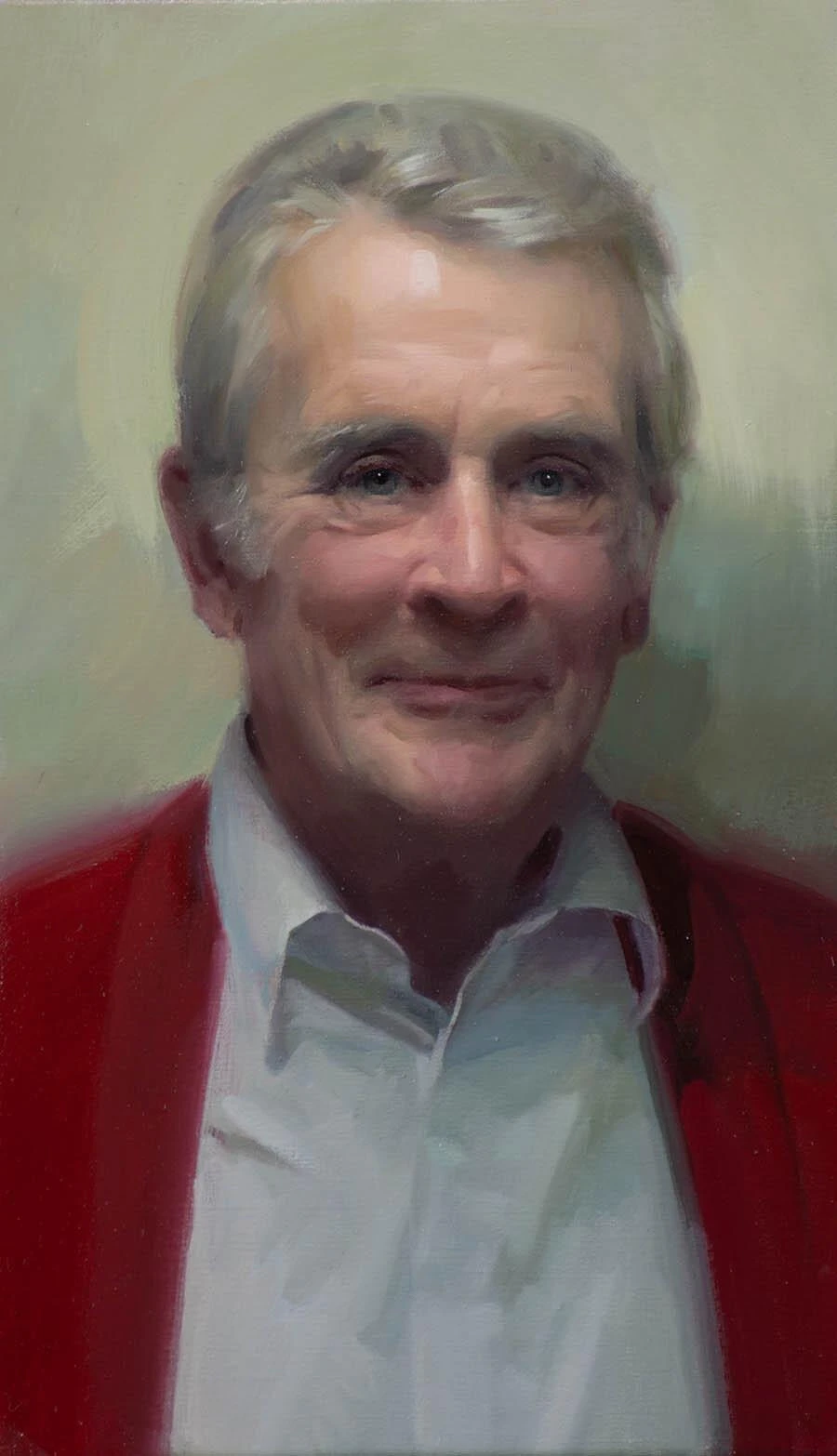
Portrait of a Gentleman
Your portraits balance a strong sense of likeness with quieter details of gesture, posture and expression. When you first meet a sitter, what are you looking for beyond their physical appearance?
When I first meet somebody, I want them to forget, and as much as it’s possible, that they are being stared at! This is why I’m so keen to get them into a conversation. But also by conversing with people their automatic behaviour becomes more and more apparent. In those first settings you may well change your composition if a certain gesture becomes prevalent. It can be a challenge to maintain the flexibility beyond the beginning of the painting process, but it can pay dividends later on.
Your painting Turning Thirteen, a portrait of your daughter, was selected for the HSF Kramer Portrait Award 2026. Could you tell us about the painting and what you wanted to capture about that particular moment in her life?
I noticed during the summer last year that she was growing out of a long phase of childishness into adolescence. I felt a need to capture that vanishing hour. Many of the paintings of my kids contain the same spirit of capturing fleeting moments. Of course my technique is stretched over a great deal of time so some of the later sittings (squeezed in around School) were months after the first, and she has grown her hair out since the outset, so she seemed in flight even during the months I painted her - probably about three months from start to finish.
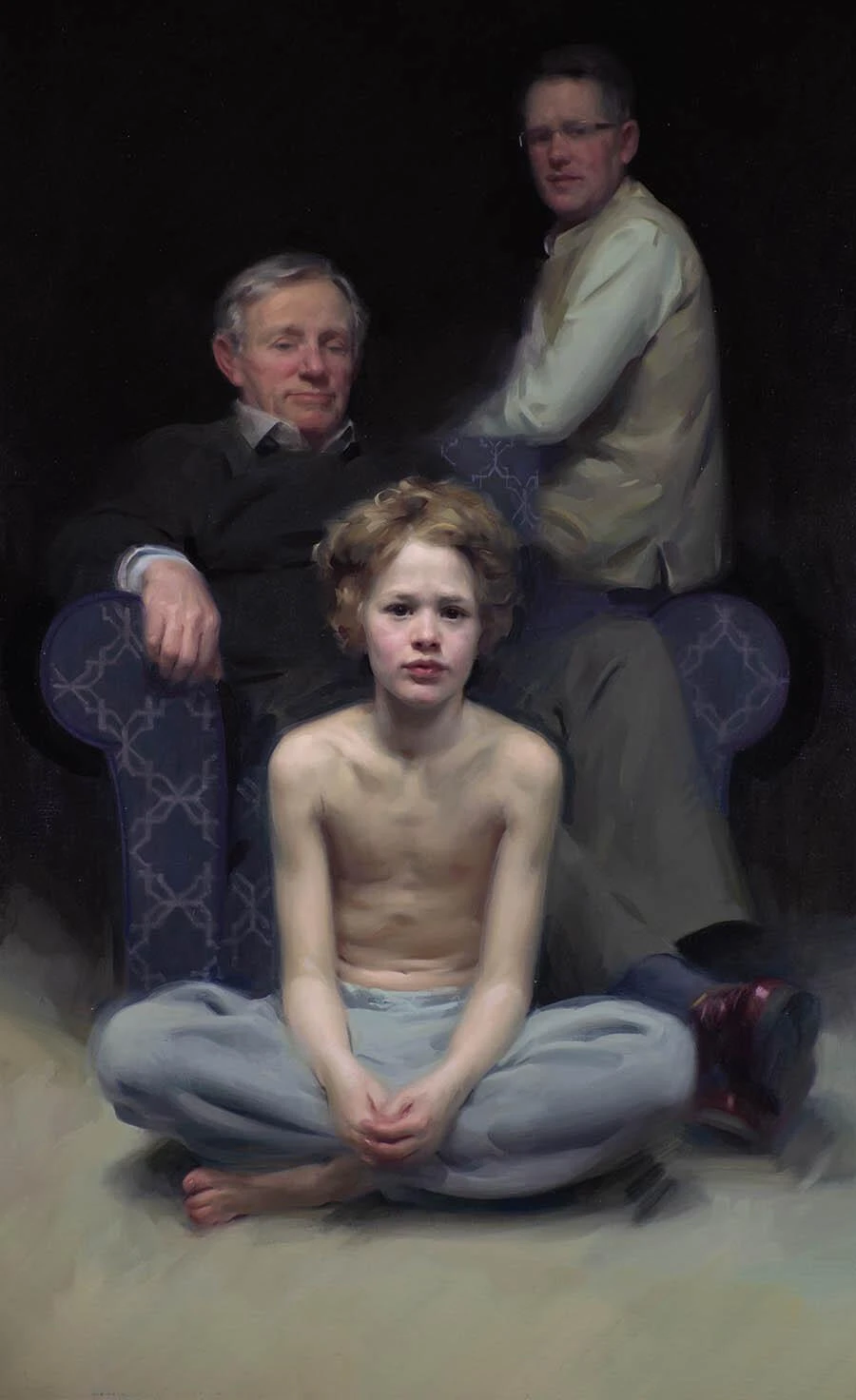
Seasons, My Son, My Husband, and Mu Father in Law
The composition arrived fairly naturally from the colours I wanted, gold, bronze, greens and blues, and the languid standing pose that we worked out over the course of an afternoon (not comfortable I am informed!). Since I was able to set up a very useful backdrop and even set up the skirt when she wasn’t there, I was fortunate to have all my materials at hand in the studio even if my daughter was often absent.
The painting evolved along the usual lines for me, and I edited out much of the background eventually, focusing more on a symbolic rendering, which I felt had more of a modern Mucha like aesthetic, and seemed more appropriate to her.
For artists developing their own approach to portraiture, what would you encourage them to pay closer attention to when working from life, whether that is the sitter, the light, the materials or simply the time spent looking?
I would encourage all young artists to spend as much time painting from life as they can, both nude and portrait ideally. It doesn’t necessarily mean that you’re going to paint every stroke from life in your future work but it is a grounding that makes an artist fully alive to the natural world that they seek to capture.
Check out more of Frances' incredible work on her website francesbellpaintings.co.uk and be sure to follow her on Instagram @frances_bell_paintings
Add To List
Add a Wishlist
form to add wishlist here