Artist Interview: Laurence Tidy - Winner of The Cass Art x Phoenix Studio Award 2025
Posted by Liesel on 5th Aug 2026
At Cass Art we continue to support the next generation of artists through various prizes, awards and opportunities. Each year Cass Art, in partnership with Phoenix Art Space and University of Brighton, sponsors a free studio space for a year for graduating students.
We caught up with Laurence Tidy, winner of the 2025 award to find out more about his experience at Phoenix Art Space, how the space has helped him develop his practice since graduating, and his plans for the future.
Hi Laurence! Firstly, congratulations on receiving the Cass Art & Phoenix Studio Award. How did you feel when you heard you'd been selected by the panel?
Thank you. I felt amazing really, quite shocked. I was in the public library with a tutoring student and I went to get a coffee and I checked my emails; when I was ordering I saw the subject line and saw it had high priority and I was just completely taken aback really. I knew what was coming! I was quite shocked and just so over the moon and overwhelmed.
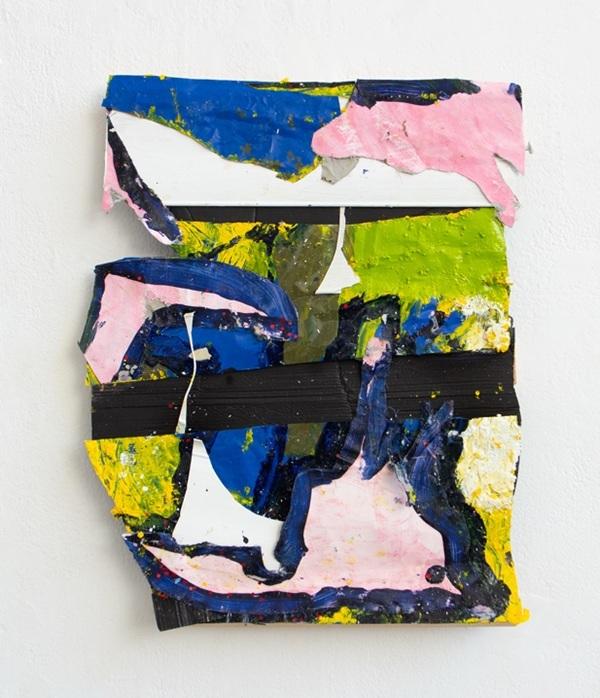
Escape Closet, 2025, blinds, emulsion, floor protectors, glitter, linseed oil, oil paint, pastel, plastic wrap, PVA, superglue, 52 x 41cm (part of Laurence’s Studio Award application)
Can you tell us a bit about your creative journey so far? You studied Fine Art Painting at The University of Brighton, graduating with a first class (hons), tell us about your time there and how your work evolved throughout your course.
Well my creative journey began in earnest when I decided to do a foundation at the Met in Brighton as a mature student. That opened the door - I remember thinking how could I possibly not continue to do this, to explore; so I applied for the painting degree. When I got a place on the Brighton course I was just so excited.
I was really experimental in the first year, learning a lot about methods and materials. I was all over the place testing out different ideas; it was only in second year that I got going with a focus in collage.
Beginning second year I was painting in oil and impasto but I couldn't get away from difficult subject matters that I didn't find much joy in painting. My tutor Alex Pollard suggested I cut up my paintings and that ignited the spark. It took me out of kind of my comfort zone and introduced surprise and play into my process. Instead of what I consciously chose to focus on it became about making, cutting and just doing. From there on the work became bigger and more sculptural, using mixed materials, which led me to assemblage.
So the creative journey I've been on is one of discovering making - the process of assembling something, putting something together - and also of sculpture. That is something that I did not know about myself when I started - I did not know I wanted to do that. Now I think I've very much built a practice around sculpture.
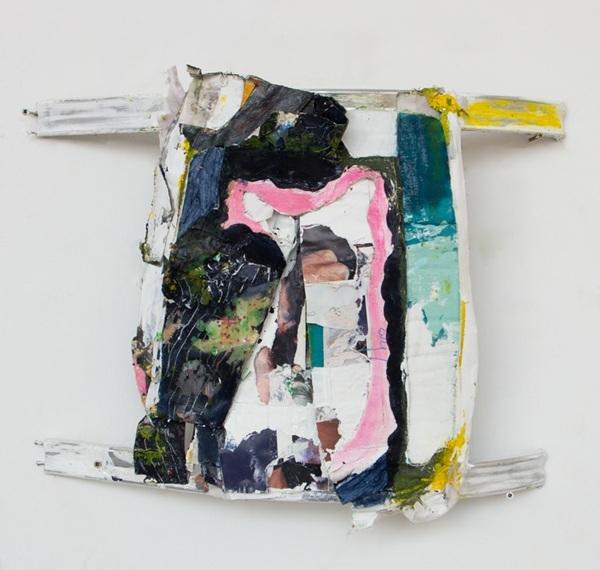
Chastity Trojan, 2025, acrylic paint, aluminium panels, book pages, cotton, emulsion paint, oil paint, pastel, pencil case, Poska pen, PVA, screws, sleeping mat, superglue, 75 x 58 x 18 cm (part of Laurence’s Studio Award application)
When assessing your application for the Award, the selectors were impressed by your experimental use of materials, which included cardboard, gaffer tape, book covers, foil, and floor protectors, alongside more conventional art materials. What does using such an eclectic mix of supplies bring to the work and your enjoyment of making it?
I think my use of those materials was not that experimental. Certainly, those materials do not often turn up in art works, but an experiment needs a question to explore with elements kept the same and others that change, in order to find a result. I relied on varied found materials and acts, whose consequence I was not sure of, but without a sustained inquiry to guide the making. Whilst I went on a journey and found engaging compositions, relationships and emotional responses along the way, I feel critical now because the works shot off in different directions.
A year on, I am exclusively using card – a more conventional material – but in a more focussed manner, with specific concerns brought forward. The card is sourced from Protectafile in Bolton. I frequently figure out how to translate parts of my drawing into 3D form through sketching in a Seawhite of Brighton sketchbook. I use a Swann-Morton scalpel to design and cut those shapes and forms. In this way, I think I have begun to think about synthesising shape and form, where the formal action of the card supplies some of the shape; in my degree show work I tended to treat shape in a flat way sometimes, rendered on the surface of an assemblage.
When drawing, I have a Staedtler rubber from Cass Art and I also love my MILAN pencil, with its gorgeous eraser end (thanks Jim!).
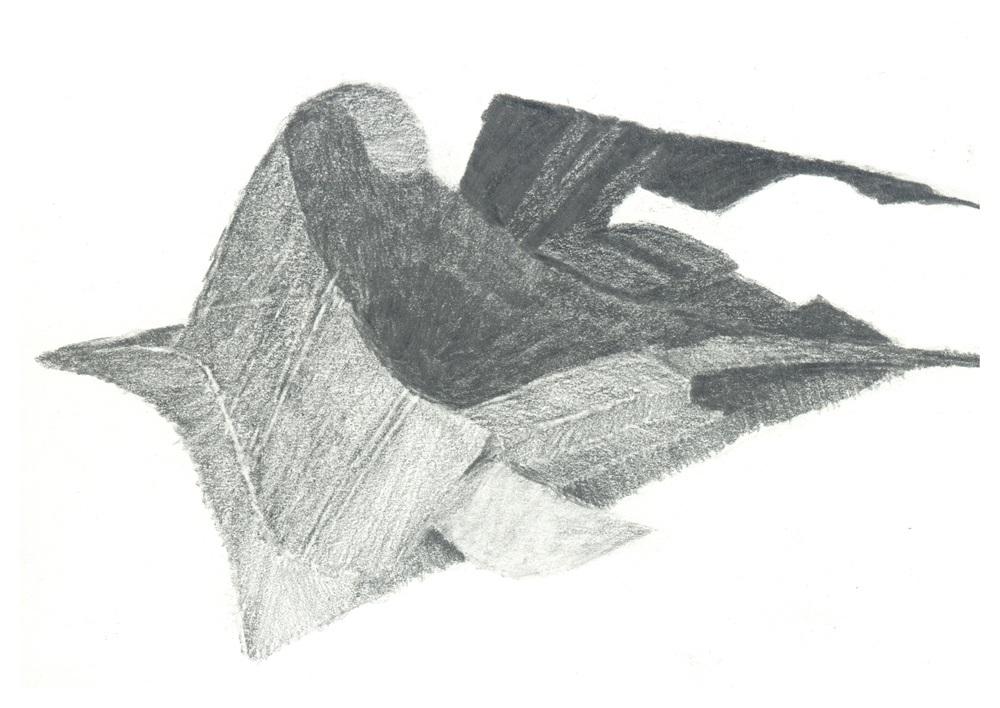
Hangar #1, 2026, pencil on card, 21 x 14.8cm
You continued to experiment in the studio at Phoenix Art Space, and your work has evolved again. Far from the colourful assemblages of your degree show, the new body of work feels serene, with a focus on simple materials – pencil and paper. The plain white of the paper works allows the viewer to reflect on your clear love of form, construction and composition. How did these sculptural works develop?
Thanks for your reflection and use of the word serene. That makes me happy!
This work developed by focusing on form and finding answers to reoccurring questions, such as what material to use, how will it be hung, what inspires my making process, and how do I make my practice more environmentally conscious.
Making mixed media assemblages from November to January, there was too much going on in the works. I doubted over their meaningfulness. Small things along the way made me consider how materials were 'doing' something; incorporating fabric, card and paper, I could see them creating folds, arches and bends.
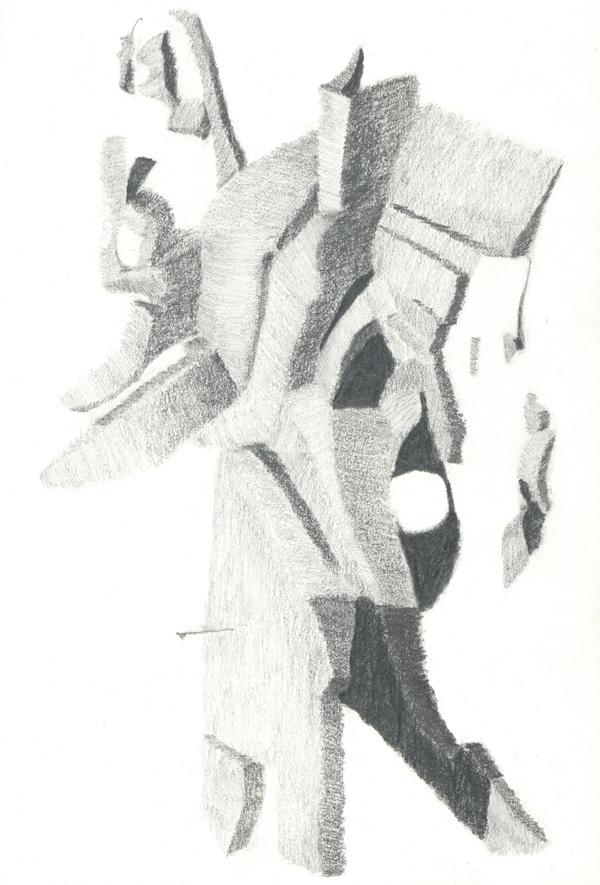
Floating City #2, 2026, pencil on card, 14.8 x 21cm
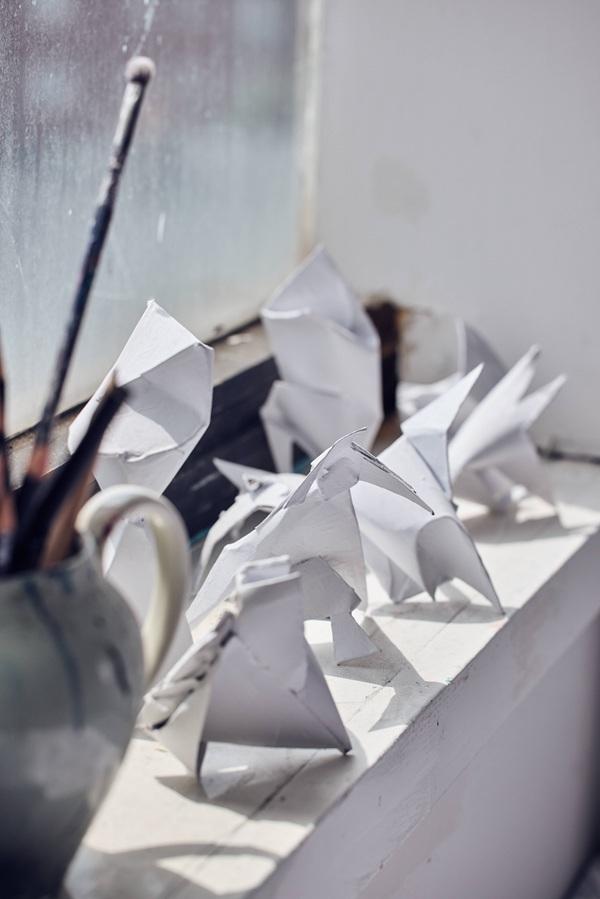
Ten quick small postcard works helped me find forms, painting them white to isolate this aspect. They inspired me to start drawing again. Six initial line compositions made me think I could use line drawing as a scaffold for creating forms through shading. The tonal drawings I made in turn supplied a new formal vocabulary and stirred my imagination.
Before returning to sculpture I had questions to answer. I had settled on card as a material but I wanted to see how I could join material together without adhesive, having always relied on superglue. I found I could make slits in the card to join the forms, using this same method to hang them on the wall through card 'joints'.
Finding forms, compositions and ideas as I went was offering too many directions initially. So after weighing up different processes, I concluded by basing my sculptural forms on my drawings, and ultimately this led to making Tableau 1 and 2 for Flights.
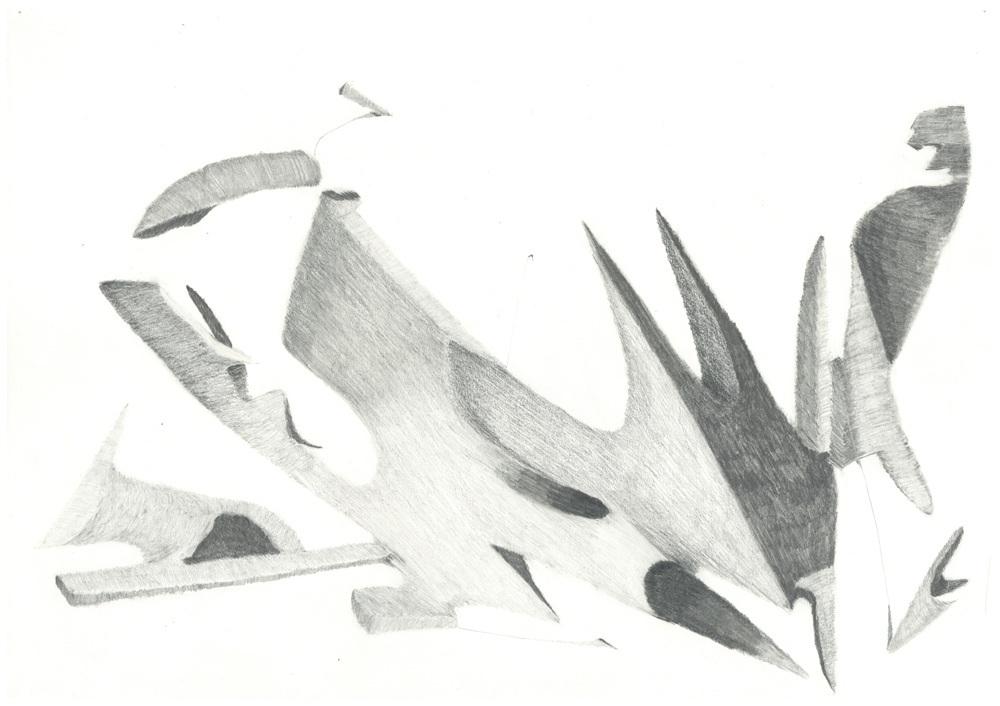
Memories of Flying, 2026, pencil on card, 29.7 x 42cm
Similarly, your recent drawings are explorations of tone and shape, do you see these as preparatory works for your sculptures, or are you content to allow the work to exist in 2D form only?
Initially I saw them as drawings and not preparatory drawings for sculpture. I felt that I was sculpting form in pencil, even in line drawings where you can imagine relationships in space between foreground and background or positions between objects. One Friday I was walking to the studio and thought, if I'm going to work in sculpture then maybe I should draw tonally. So I began the tonal drawings. That was the start of fleshing out these drawings into forms and something that has presence. At that point they were not preparatory works but done in their own right.
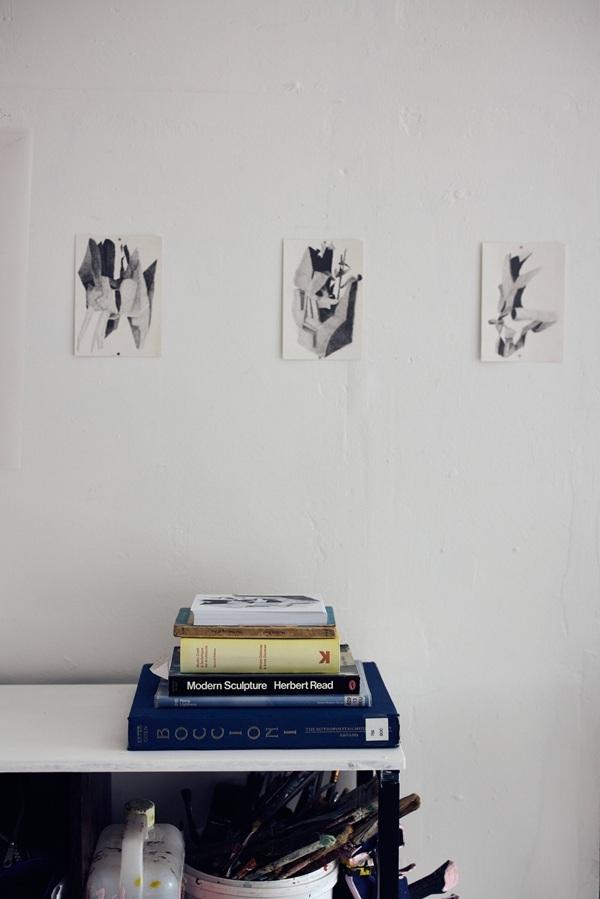
After three initial A3 drawings I experimented with process. The A3 drawings use lines set down through unsighted line-making, afterwards proceeding to build form through erasing and shading, however in the A5 series I use shapes traced from various printed and digital images which included phenomena formally similar to the visual language that was then emerging - boats, warheads, architecture. Coming back to sculpture, I needed a basis for my formal work and the drawings offered a whole vocabulary of actions and forms, such as floating and turning, gargoyles and rockets. It provided this whole imaginary and basis for sculptural inspiration.
At the end of 2025, you curated a group show States of Assemblage, in St Leonards. What motivated you to curate the show and what did you gain from the experience?
I wanted to have a go at curation. Generally I feel assemblage is a less well-known artistic term - I wanted to research it, for my own practice, and to bring together contemporary practices in Sussex that aligned with its spirit. 2026 marks the sixtieth anniversary of The Art of Assemblage exhibition at The MoMA in New York; I thought it would be nice to coincide my show with the beginning of this anniversary year.
Without Bee Nichols, who ran Unit 2 while it lasted in St Leonards-on-Sea, the project would not have happened. The space she created was open, inclusive, affordable, and championed emerging artists and curators. Thanks to Unit 2, 30 artists, and the help of my friends and girlfriend, the show was possible.
I had so much fun. I met many artists, including two linked with Phoenix, I encountered a range of practices and works, and I had an exhilarating and stressful time installing the show, with a lot to do in a short time and with many hanging challenges to overcome with Ailbhe, my girlfriend. I learned more about assemblage and how to hang works. It also affirmed my inkling that I would enjoy curating and bringing works and people together.
You've got a month or so left of your studio residency now, what has it been like being part of the creative community at Phoenix Art Space?
It has been fantastic. I would like to have been more involved in studio member life than I have been - there have been members meetings which I've not been able to attend because of work. Nevertheless I've loved being around my studio neighbours: they have been and are so welcoming, helpful and interesting. The staff also. It's a privilege to be part of the studio member's show, Beyond the Studio, marking 30 years of Phoenix; I am showing alongside Phoenix veterans!
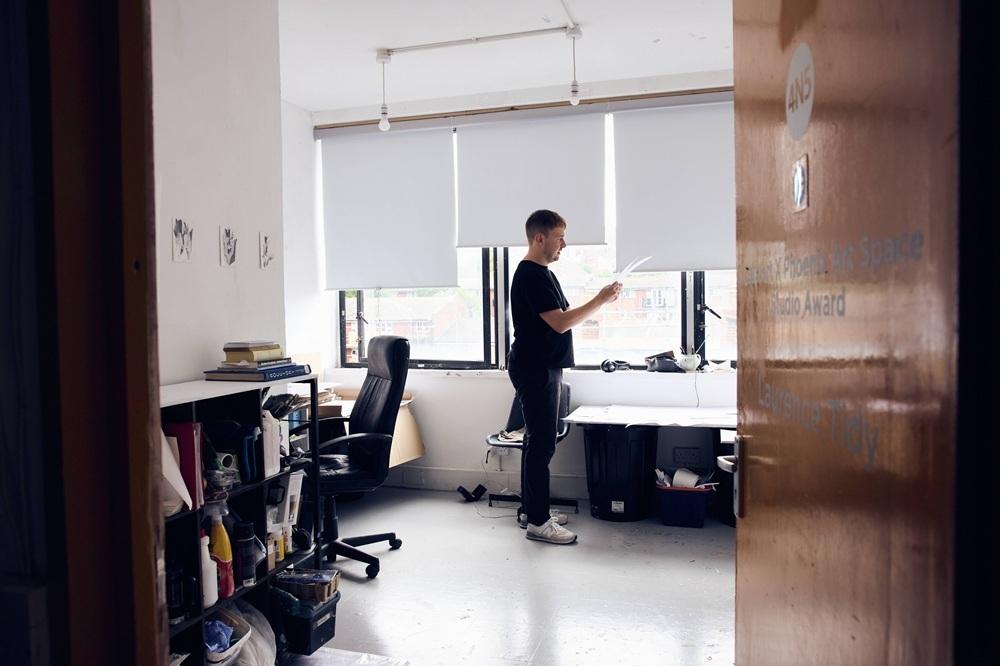
I found the Open Studios in May really insightful and nourishing too: great to meet new people and get feedback. People have such interesting angles that they bring to your work, so I can't wait for the exhibition in that respect. Lastly, the studio space has been fantastic. It's so great to get a space to yourself and to allow yourself to design it how you want, to do what you want with it. It's such a massive privilege.
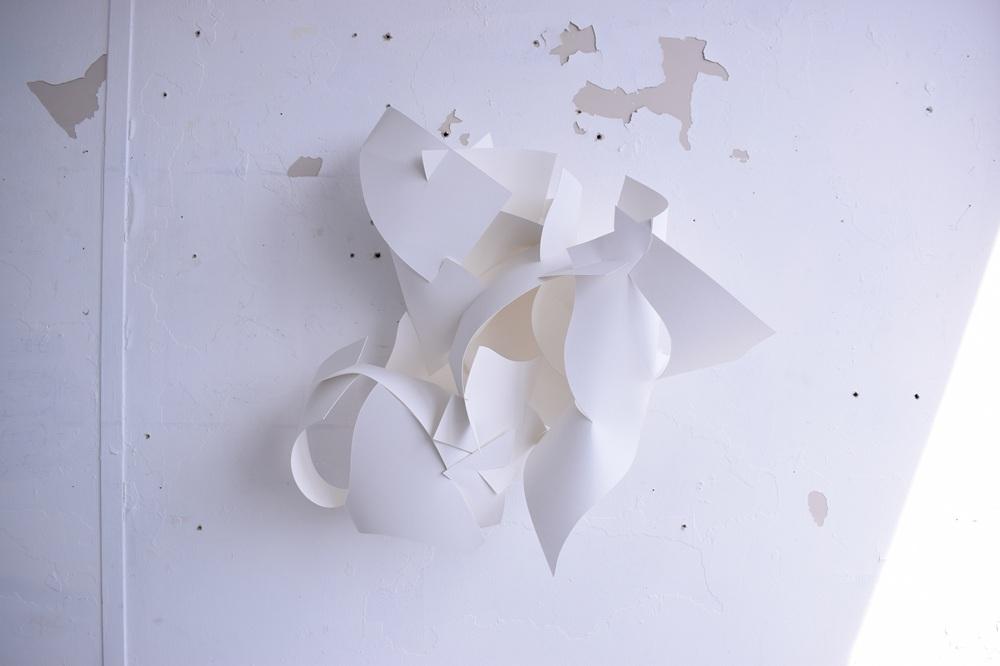
Work in progress, 2026
Tell us about your forthcoming solo show at the Phoenix Art Space Window Gallery.
It's called Flights. It is the culmination of my sculptural experiments and my attempt to develop a way of making work in card that communicates the formal language I've fallen in love with.
It will feature two new works (Tableau 1 and 2) and are the largest works I've made. They are installations, which is quite pertinent, because - I don't know if you remember, Liesel - when you came to visit my studio in November, that was one of the first things you asked about my mixed-media assemblages - whether they were installations. At the time I found that surprising: I never thought of my work that way. But it turns out you were onto something!
It will feature drawings and sculpture which try to communicate a shared formal, visual and sculptural language. It's about movement, turning and curving, with structures that resemble floating civilisations, flying craft, or the conjunction of distinct forms, from the technological to the mythical and animal. It's about light and shade, the cultivation of presence, and the movement of the eye and the movement of line. I hope it stages a dream-like imaginary of forms, untethered and suspended.
I am very excited!
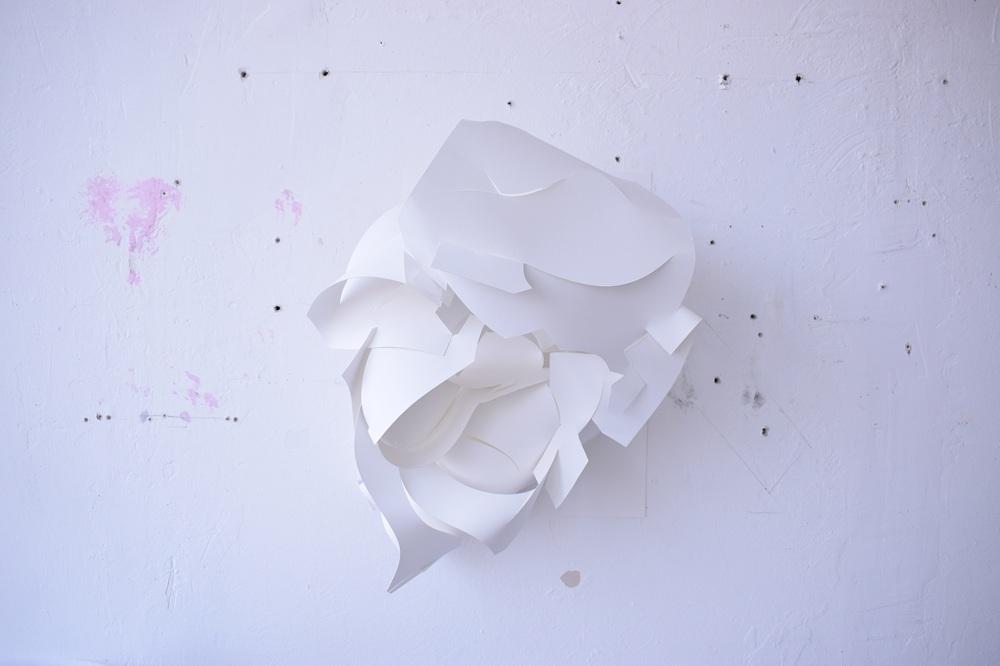
Work in progress, 2026
What else do you have in the pipeline, Laurence?
I have been working flat out on the Tableaux since mid-May, so I am really looking forward to a break. There's been a lot of late nights and long, sometimes very hot, hours put in. I am excited to share the work with my family and friends and to meet anyone who comes to see Flights when I am in the gallery.
Extending the pipeline, I will be moving from Brighton. I am looking into places, opportunities, and institutions where I am able to deepen and build on my work and methodology, learn more about paper and paper-making, and find interdisciplinary opportunities. For example, I am interested in translating these sculptures into costumes or set design, and in digitising, reproducing and sharing the templates for the Tableaux.
One idea is to work out how to make and package a small, DIY version of a detail of the Tableaux that anyone could assemble - like those packages with airplane parts that used to come with magazines (I think). You'd take out the parts, put it together and fly it.
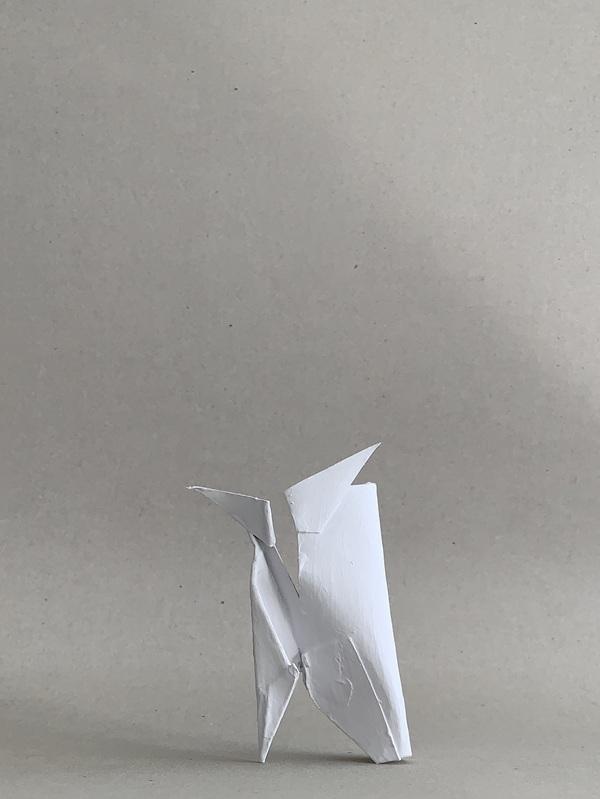
Marriage, 2026, postcard of Seyðisfjörður, paint and glue. 8.5 x 5 x 2cm
Thanks Laurence!
Visit Phoenix Art Space at 10–14 Waterloo Place, Brighton, BN2 9NB to see Flights from 7th - 30th August 2026. See Beyond the Studio: a celebration of artists and makers at Phoenix until 13th September 2026. Both shows are open Weds - Sun 10am - 5pm. Admission is free.
Find more of Laurence’s work at laurencetidy.uk
Image credits:
Images 1, 2, 8 & 9 © Alun Callender Photography aluncallender.com @aluncallenderphoto
All other images © Laurence Tidy

